|
Words of Wisdom
"Truly, I have treated this matter (of agunah) at great length because I am aware of the tendency of some of our contemporary sages … to avoid all possible doubts and controversy in their quest for clear and indisputable halachic rulings, free of any objection or dissent. And while it is true that this the good and proper approach with regard to all other halachic questions, when dealing with the chaining of women, I do not follow it. Rather, I follow the paths trodden by early and later sages who exerted their maximum efforts in searching for any and all conceivable ways to be lenient in the matter of agunot."
AGUNAH INTERNATIONAL Inc. – A LIFE IS A TERRIBLE THING TO
WASTE
Articles and Halachic Material 1. “Halachic Principles and Procedures For Freeing Agunot,” Aranoff, Dr. Susan. The Jewish Week. August 28, 1997. Abstract: The first formal statement setting forth the halachic foundations of The Beit Din L’Inyenei Agunot.
2. “Some Thoughts On The Problem Of Agunot,” Toledano, Rabbi Haim.
June 13, 2000. 3. “A Response To The Beth Din of America,” Aranoff, Dr. Susan. Winter, 1998 Abstract: A rebuttal of the Beth Din of America’s letter to the membership of the Rabbinical Council of America in which they challenge the halachic decisions of the Rackman Beit Din 4. Two Views of Marriage – Two Views of Women,” Aranoff, Dr. Susan. Nashim, Spring/Summer, Number 3, 5760/2000. Abstract: A brief history of The Rackman Beit Din; a restatement of the beit din’s halachic foundations; and a rebuttal of Rabbi J. David Bleich’s critique of the beit din.
Abstract: A description in layman’s terms of the halachic underpinnings of the Rackman Beit Din in light of the Orthodox rabbinical establishment’s refusal to recognize it. 1. Halachic Principles and Procedures For Freeing Agunot
This exposition of halachic principles and procedures,
KIDDUSHEI TA’UT I: A SALIENT DEFECT
One category of
kiddushei ta’ut is the voiding of the marriage because a salient defect was
not disclosed to one party, in our case the bride. When the salient defect
reveals itself, the wife has the right to declare to a beit din
“Had I known of this defect, I would never have married him.”
The groom’s failure to disclose
does not have to be with fraudulent intent on his part.
It may be that he himself was not aware of this problem. For example, a groom may be impotent and unaware
of this at the time of the marriage. When this condition becomes apparent,
the marriage is voidable even though the groom did not willfully conceal this
information. (Rav Moshe Feinstein Igrot
Moshe EH I:79) Of course, in the case of willful concealment,
a fortiori, the marriage is voidable.(ibid. 80)
See also Or Zarua (c.1180-1250) who records (761) a case in which
his contemporary Rabbenu Simchah of Speyer ruled that a wife should be released
without a Get on the grounds of kiddushei ta’ut when an unknown
defect in the groom is revealed. Building on this concept of kiddushei ta’ut, a beit din may recognize other intolerable defects in the husband as grounds for a declaration of kiddushei ta’ut. These defects – which are in total discord with any reasonable concept of marriage – include: physical and psychological abuse, adultery (which more than ever endangers the life of the spouse), sexual molestation, abandonment, criminal activity, substance abuse, and sadism (the withholding of a Get may be viewed as indicating a sadistic nature). A beit din, applying a psychologist’s or psychoanalytic concept of human nature, may hold that the seeds of such deviant behavior are present in the groom at the inception of the marriage though they may not yet have expressed themselves in overt behavior. These personality defects are so categorically unacceptable in marriage that the wife may testify, “Had I known that he had these personality defects, I never would have married him.” The method of freeing a woman based on a finding of kiddushei ta’ut I is buttressed by the insight of Rav Yitzchok Elchanan Spektor who wrote a century ago that when a defect in the husband justifies coercion of the Get, the Talmudic presumption of tav l’metav tan du mi’l’metav armelu -- a woman is better off married to anyone than being alone -- is not applicable. (Ein Yitzchok Vol.I 24:41.) Once this presumption is suspended, a woman can credibly testify that had she known of salient defects in her husband she would have chosen not to marry, the marriage was a mistake, she would be better off alone.
The argument that women prefer to remain single rather
than endure a miserable marriage is even more persuasive today given the
increased economic and social autonomy women have achieved in our times.
Rav Moshe Feinstein, in discussing tav l’metav (op. Cit. 79),
considers the remote
theoretical possibility that the inability to be self-supporting might induce
some women to tolerate marriage to highly undesirable men.
He goes on to say that only a small minority of women, if any, might be so
economically desperate. In 1998 still fewer, if any, women would
fall into this category.
All the more reason to maintain that
women today would rather be single than be married to abusive men. The concept
of tav l’metav is outmoded and no
longer an impediment to declaring kiddushei ta’ut.
In every case before our beit din, the latent
defects of the husband gave rise to such abusive behavior as to render them
unfit to be husbands. The agunah’s testimony that had
she been aware of her husband’s true nature she never would have married stands.
The marriage is void ab initio – KIDDUSHEI TA’UT I. The beit din may dispense with a Get
and release the woman with a p’tur.
KIDDUSHEI TA’UT
II: LACK OF INFORMED CONSENT WHEN KEFIYAH (PHYSICAL COERCION) IS IMPOSSIBLE
The availability of kefiyah
(physical coercion) in the past, when Jewish courts had the power to enforce
their own orders, did much to achieve the liberation of agunot from
impossible marriages. Today the unavailability of kefiyah is the firm
halachic basis for liberating agunot on the grounds of KIDDUSHEI
TA’UT II, a lack of informed consent by the bride. For had these women
known at the time of marriage that they were agreeing to a union in which
they could be literally imprisoned by an unscrupulous husband,
they never would have consented – kiddushei ta’ut. When rabbis tell these women that they are
shackled forever to vicious husbands, these women can rightfully say, “Had I known that this was the nature of the
marriage relationship, I never would have wed.
I did not enter this marriage surrendering control of my life to my husband no
matter how abusive he might be.” Our experience has shown that agunot are
stunned when the rabbis they turn to, often the same rabbis who taught them in
school or officiated at their marriages, tell them that rabbis have no power to
sever such oppressive marriage bonds.
The Historic Role of
Kefiyah
Probably the best known halachic authorization of
kefiyah to secure a Get is found in the Rambam.
Writing in the 12th century he lays down the rule that a
Get should be coerced when a woman says her husband is ma’oos, repugnant to her. (Hilchot Ishut
14:8) Elsewhere, the
Rambam (ibid., 25:11, see also the Mishnah Ketubot 7: 9,10)
calls for kefiyah when the husband develops certain physical odors or
assumes certain malodorous or repulsive occupations.
The Or Zarua cited above authorizes kefiyah in a case where the
woman involved wanted to exit her marriage not because
the husband was guilty of unconscionable behavior, but rather because he had
tragically become blind. How much
more is kefiyah warranted in cases where a man is no longer a husband but
a tormentor.
As early as the 13th century,
the Rashba must have discerned that brides would not wed if they did not
trust that rabbis could free them from bad marriages by coercing a Get.
(See Hiddushei HaRashba Gittin 88B) It is very relevant here, even if
parenthetical, to describe fully the rationale of the Rashba and his
reason for justifying the exercise of physical coercion against recalcitrant
husbands despite the incontestable Talmudic affirmation that rabbis have only
limited power to decree corporal punishment since the conferral of Biblical
Semicha (ordination) came to an end a thousand years earlier. Yet the
Rashba approved of physical coercion of the husbands of “chained”
women using the same reasoning that prompted the rabbis to exercise their
rabbinic power to force debtors to pay their creditors what is due them, because otherwise the poor would not be able to
borrow money. “The doors of
creditors would be closed to them.”
In a similar way, the Rashba said that women would not marry if they had
no exit from marriage to a man who has become their tormentor.
Kefiyah Is Unavailable
Today
It is particularly in this decade that it has become
apparent that physical coercion is both unacceptable and illegal.
In Israel, coercion is limited to non-violent means and is, therefore, limited
in its effectiveness. So
vindictive are some recalcitrant husbands that they have elected to remain
incarcerated in Israeli prisons rather than free their wives.
In the United States, violent self-help by rabbinical courts is unlawful and
punishable. Several American rabbis are under investigation by government
prosecutors because of suspected links to violence against recalcitrant
husbands. Rav Moshe Feinstein was concerned with the fact that the power to coerce a Get was useless if the husband had fled from the jurisdiction of the court or his whereabouts were unknown. He wrote “ V’af b’zman sheh’yad Yisrael tekifah sheh’kofin ohto le’hotzi, yesh harbeh pe’amim sheh’lo to’il hakefiyah, sheh’lo yomar rotzeh ani oh she’lo yoochloo l’kofo, she’yivrach ve’chadomeh; ve’kol sheh’ken b’zman hazeh she’ein b’yad beit din yisrael l’kofo……Ee efshar le’hasig mimenu Get be’shum ofen, ein le’agnah ve’yesh le’hatirah mi’ta’am mekach ta’ut… And even in the time when Jews had power to coerce the husband to release (the wife with a Get), many times the coercion would be ineffective, (he) would not say I am willing (to give the Get), or it would be impossible to coerce him, he would flee, or the like. All the more so in these times when batei din do not have the power to coerce…… It is impossible to secure a Get from him by any means, she should not be left an agunah and should be released because of a fundamental mistake in the marriage. (Rav Moshe Feinstein, EHI:79)
These words of
Rav Moshe Feinstein resonate in every case heard by us. In each case, our rabbis
found that the husband’s behavior was ma’oos - intolerable to the wife -
and warranted a declaration of
kefiyah.
In each case the husband had refused to issue the Get despite various
combinations of pleading, pressure and efforts by other batei din.
Like Rav Feinstein, our rabbis concluded:
When it is impossible to secure a Get by any means from such unfit husbands, the
woman should not remain an agunah.
She should be released on the grounds of kiddushei ta’ut II.
It is not only pre-existing defects in the husband that make a
marriage kiddushei ta’ut. It is the woman’s mindset at the wedding that she was not
delivering herself into a marriage with no exit. The marriage is void ab initio – KIDDUSHEI TA’UT II.
The beit din may dispense with the Get
and release the woman with a p’tur.
KIDDUSHEI TA’UT III: LACK OF
INFORMED CONSENT
TO KINYAN
Recently, Professor Meir
Feldblum, formerly of Yeshiva University and now of Bar Ilan University,
published an incisive article (Dinei Israel, Tel Aviv University Law
School, 1998) that focuses on the Halachic implications of the lack of
informed consent by women at the time of marriage. Feldblum writes that “in light of women’s efforts in our day to achieve
equality in all spheres of life, there is a presumption, even a categorical
presumption (umdena d’muchah), that many women if informed would
in no way agree to the kinyan/acquisition nature of kiddushin/marriage.”
Consequently, Feldblum argues, many women seeking a divorce may not be
halachically married, not mi’d’oraita-Biblically, and perhaps not
even mi’d’rabbanan-rabbinically, and therefore may not need a Get
to exit the marriage.
Our actual experience with agunot exceeds that of
Professor Feldblum and has led us to conclude that no woman views marriage as a
transaction in which her husband “acquires” her.
No one can credibly maintain today that brides are consenting to the concept of
gufah kanui, that marriage is a kinyan in which the husband acquires
title to the wife’s body. (See the Babylonian Talmud, Bava Batra 48B,Tosafot
beginning Kaddish b’biah..) Thus there is no informed consent by women to
kinyan at the time of marriage and the marriage is void ab initio,
KIDDUSHEI TA’UT III. The beit din may dispense with the
Get and release the woman with a p’tur. CONTINUITY WITH PAST WHILE ADDRESSING PROBLEMS OF THE PRESENT AND FUTURE
Kiddushei ta’ut has been a central concept in halachah for centuries. We have broadened the range of defects that constitute grounds for kiddushei ta’ut and reaffirmed that the absence of informed consent on the part of the bride constitutes grounds for kiddushei ta’ut. We have acknowledged the dramatic change in women’s economic and social status which renders the Talmudic presumption of tav l’metav rebuttable in every case, if not completely obsolete, and which undermines the fundamental concept of kinyan at the time of marriage.
HALACHAH PROVIDES A SOLUTION
Our critics say there is no solution. We are proposing one that is not only justified by the halachic authorities but mandated by them. To liberate an Agunah one must even rely on minority views. (Taz Even Ha’ezer 17:15, Taz Yoreh Deah 293:4) To prevent aginut, testimony does not have to meet standards of Biblical drishah and hakirah. A single witness, circumstantial evidence, and hearsay are all admissible. (Rambam, Hilchot Gerushin, 13:29.) Fear of mamzerut is an illusion. (See the Responsa of the Maharsham 9)
The pursuit of a more stringent post-Shulchan Aruch
view of Jewish law is a reversal of a two thousand year commitment to the
liberation of all suffering women and a reversal of
the thrust of Jewish law since the beginning of our history to liberate women
from slavery of any kind, including ownership by her husband.
_______________________________ AGUNAH International Inc. 212-249-4523~~~~~~~~Mipnei Tikkun Olam (Gittin 4:2)
2. SOME THOUGHTS ON THE PROBLEM OF AGUNOT BY: Rabbi HAIM TOLEDANO It
must be stated at the outset that the current agunah problem in the
United States, France and elsewhere is fundamentally different from that
of the past in two important respects. Following are several ideas and precedents culled from various sources as well as some of my own thoughts on the subject.I
Duty of Rabbis to Try to Alleviate the
Plight of Agunot.
Following this preamble, the rest of this lengthy responsum deals with the substantive halakhic issues involved. The various statements quoted by R. Yosef in the preamble to this responsum are most instructive in that they show how these decisors were ready to go to any length to alleviate the plight of agunot. sampling of these extraordinary statements follows. A.
" He who resolves the problem of even one single aguna in these times [has
the same merit merit] as he who rebuilds one of the ruins of the heavenly
Jerusalem..."
The Shebut Ya'akob
(vol. I, no.14), states: "It is permissible for bet din to convene
on Saturday(which is otherwise forbidden) in order to hear the testimony
of a dying witness [with regard to the death of a husband] so that his
wife may be freed from the status of agunah, and they must not wait
until after Shabbat, for there is no greater emergency,(sha'at ha-dahak)
than that of freeing agunot. And one must not tarry in the matter
of agunot just as one may not tarry when the saving of life (pikuah
nefesh) is involved."
R. Haim Palagi in his
Hikeke LeB and in his Hayim ve-Shalom quotes the opinions of
later halakhic authorities (aharonim) at length to show that, "It
is incumbent on every decisor to research and examine as many halakhic
works as he is able to in order to find a solution (heter) for the
agunot, and whoever exerts maximum efforts in trying to find some
opening and in looking for any conceivable way to free the agunot
is praiseworthy."
The Dibre Emet
states: If every rabbinic scholar (talmid hakham) refrains from
issuing a ruling [in cases involving agunot] saying 'what am I
getting into, a place of blazing fire! considering the seriousness and
graveness of the prohibition of adultery'... Truly, [our sages] say, this
is neither the correct way nor the proper approach. Rather, every rabbinic
scholar, of major or minor stature (ka-katon ka-gadol), must search
with a fine tooth comb [the author uses the interesting imagery of the
search for chamets--hipus me-hipus ba-horim u-va-sedakim] in the
hope of finding an effective remedy for the welfare of the daughters of
Israel to deliver them from their agunah status."
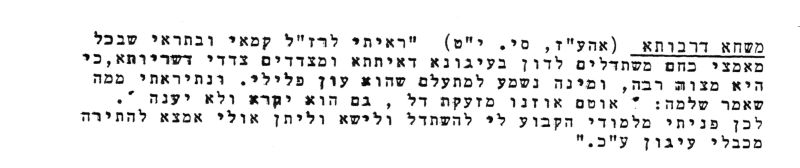
The Mishha di-Rebuta
states: "I noticed how our sages, both early and later masters, exerted
great efforts in trying to deal with the problem of agunot, and
always came down on the side of freeing
agunot, for it is a great mitsvah. And by implication, it is
clear that ignoring the problem constitutes a grave sin (avon pelili).
Wherefore I became freightened by the [implication of the] saying of
Solomon, "He who stops his ears at the cry of the wretched, He too will
call and not be answered' (Prv.21,13). I therefore took time out of my
regular schedule of study and concentrated on examining the sources in the
hope of [finding a way] to free women from the chains of igun. "
The Teshuvot Memar Hayim states; " It is incumbent on whoever bears the title of rabbi to turn away from all his preoccupations and free himself from all his studies, and force himself to search and look for a way to help the daughters of Israel so that they do not end up as agunot."
G.
The Mas'at Binyamin
writes, " Truly, I have gone to great length in treating this matter [of
agunah] because I am aware of the tendency of some of our contemporary
rabbis to avoid all possible doubts and controversy in their attempt to
arrive at clear and indisputable halakhic rulings free of any objection or
dissent. And while it is true that this is the good and proper approach
with regard to all other halakhic questions, when dealing with the
chaining of women, I do not follow it. Rather, I follow the paths trodden
by our early and later sages who exerted their maximum efforts in
searching for any and all conceivable ways to be lenient in the matter of
agunot."
"Were we to require a
thorough and exhaustive examination of the literature authored by all the
great halakhic authorities, as we do with regard to all other rules of the
Torah...to follow the majority opinion, no agunah will ever be
permitted to remarry. As a result, the daughters of our father Abraham
will remain entrapped in virtual widowhood (almanot tserurot hayot)
with no one to have mercy or compassion on them. therefore, what we must
do is follow the path paved by the early masters (rishonim) to
follow any logical and straightforward opinion (sebarah yesharah)
even if it is not agreed upon by all the great halakhic sages who are
otherwise our authorities (lit., from whose water we drink). II
Some 100 years later, in
1592, another takkanah was enacted in Fes with a view to renewing
and strengthening the one of 1494. It imposed on the husband who marries
not in conformity with it a number of sanctions and fines including the
right of the bet din to force him to give a Get.
luckily, because of the special status of the Jews in the lands of Islam
which granted them total judicial autonomy, the bate din
were in a position to enforce their decisions. There is a controversy as
to whether the new takkanah maintained or rescinded the earlier
provision of hafka'at kiddushin.
The above cases deal
with the takkanah of hafka'at kiddushin in Morocco,
Algeria and Syria. But the practice of enacting such takkanot was
widespread in other communities as well. Clearly, the circumstances
necessitating these takkanot were different from the present
situation of agunot in the U.S., Israel and France. Nor do they
deal with the annulment of marriage retroactively on the basis of mekah
ta'ut (i.e. a purchase in error, or on false pretenses). Nonetheless,
they reveal a certain boldness on the part of these rabbis. They were
courageous enough to deal forcefully and decisively with the contemporary
problems facing their communities.
III Possible Solutions For The Current Plight of Agunot in the U.S. And Elsewhere.
A. Rabbi Shalom
Messas, the Chief Sephardi Rabbi of Jerusalem, reports that in the winter
of 1984, he was invited by the R.C.A. to attend their convention held in a
major hotel outside New York. Towards the end of the convention, he was
approached by R. Clapperman and several of his aids seeking his help in
solving the vexing problem of agunot. R. Messas imnediately
referred them to a solution he had suggested in a responsum in his
Tevu'ot Shamesh (vol. III, no.66).
R. Messas also pointed out that his suggestion was based on an
identical
takkanah adopted unanimously by the Fifth Council of Moroccan
dayanim in 1954, and for the same reasons. R. Messas, who was then the
president of the bet din in Casablanca, was one of the 22
dayanim who approved the takkanah. ( Shemesh u-Magen,
vol. I, Eben ha-Ezer, no. 11, pp.233-237; see also M. Amar,
Ha-Mishpat ha-Ivri...,p.375 ). B. R. David Bleich, in his Contemporary Halakhic Problems (vol. I, pp. 155-159), discusses various aspects of a similar proposal made by R. Elyakim Ellinson in a paper that appeared in the Tammuz-Sivan 1971 issue of Sinai. R. Bleich discusses also some of the possible objections to R. Ellison's proposal and concludes by offering a possible formulation of such separate document which eliminates all such objections.
C. Incidentally, in a dialogue held in Paris (June 24,1999) between R. David Messas, the Chief Rabbi of Paris, and five representatives of different women's groups, on the subject of agunot, Ms. Annie Sebbag, an attorney who was herself an agunah, reports how she sued her husband in civil court on the grounds of “Abus du Droit” ( abuse of the law) and was awarded by the French civil court a considerable sum of money. This ultimately forced her husband to give her the Get. She is now advising other women to do likewise. ( Actualite Juive , no. 615, June 24,1999, pp.6-9). This is essentially similar to the solution suggested by R. Shalom Messas. D. R. Messas' suggestion is not much different from a proposal made by by R. Uziel ( discussed by R. Marc Angel in his book on R. Uziel ). The only difference is that R. Uziel's suggestion would include such a stipulation in the ketubbah. Also, R. Uziel's stipulation leaves it up to the bet din to draw from the husband's estate to provide for the wife and children. Unfortunately, in countries like the U.S. and France where separation of church and state prevails, the bate din lack coercive powers ,and therefore have no means of enforcing their decisions. In this sense then, R. S. Messas' suggestion is more practical and more doable since the separate document will be enforceable in a civil court independent of either the will of bet din or its disposition. ( Loving Truth and Peace...,pp. 195-196). R. Messas solution also overcomes all the objections raised by R. Uziel and others to a takkanah suggested by R. Yaacob Moshe Toledano in his Yam ha-Gadol (also discussed by R. Angel, ibid., p.197F).
E. R. Moshe Feinstein, in his Igerot Moshe,
rules that if after the marriage the husband is discovered to be impotent
or insane (and he cites physical abuse as a sure sign of insanity), that
the marriage may be annulled retroactively on the basis of mekah ta'ut
( i.e., a purchase in error or on false assumptions), and the woman does
not need a Get. R.Feinstein's compelling argument is that no woman would agree
to marry a man knowing that she can never have conjugal relations with him
or that he is insane. Rab Moshe argues further that in such cases we do
not say "tab le-metab tan du" (i.e. the assumption that a woman
prefers any marriage, no matter how bad, to a life of solitude) since the
woman cannot derive even the smallest benefit from such marriage. (
Eben ha-Ezer,Vol. I, nos.79-80, pp.182-192) .
F. In the course of a dialogue on the subject
of agunot between R. David Messas, Chief Rabbi of Paris, and five
representatives of various women's groups in Paris ( alluded to above-II,C.),
R. David Messas stated," I would like to add something important. A woman
who is unable to obtain a Get
IV
A.
Let me begin with a story. The Talmud in tractate Guitin
relates a very sad and instructive story about Kamtsa and Bar Kamtsa
(pp.55/b-56/a). Following is my take on the story, that is, the lessons I
draw from it. B. Another example that comes to mind is Maimonides’ bending of halakhah in his "Epistle of Martyrdom" dealing with the anusim under the al-Mohads in twelfth century Fes, who were forced to accept Islam outwardly, but continued to practice Judaism in the privacy of their home. The case is too involved and complex to be dealt with here, but it is very instructive. Lately, R. Haim Soloveitchick attacked Maimonides' position rather harshly as being in violation of halakhah; but R. David Hartman defended Maimonides forcefully, adducing many arguments in his defense. One of the arguments offered by Hartman is that the Epistle was not a responsum or a halkhic treatise. Maimonides' overriding concern was to save an entire Jewish community and give them hope to continue to cling to Judaism. Maimonides was convinced that the rule of the al-Mohads was temporary. History proved him right. Not long after, the al-Mohad dynasty was overturned and the Jews of Fes returned to Judaism openly. For a fine translation of Maimonides Epistle, and the Soloveitchick-Hartman controversy, see Crisis and Leadership: Epistles of Maimonides, trns. by A. Halkin and discussion by David Hartman (J.P.S.;pp.46-90).
C.
What do these and similar case-studies have to do with the
problem of agunah ? They have to do with the role and quality of
rabbinic leadership. The timidity of R. Zekharyah b. Abiklus led to
national disaster, while the enlightened boldness and flexibility of
Maimonides saved an entire Jewish community from extinction. It seems to
me that the clear lesson conveyed by these cases is that rabbinic leaders
must be the 'masters' of halakhah, not its slaves.
D.
Moroccan rabbinic jurisprudence from 1492 through 1956, and down to
the present (in Israel), as a model of bold and innovative rabbinic
leadership.
E. It may be asked, what is so
unique about Moroccan rabbis? what made them so flexible? After all, these
rabbis were not liberals in the modern sense of the word. They were the
very pillars of 'orthodoxy'. They were all great Torah giants, true
gedolim, all men of great personal piety and saintliness. Yet, they
had no hesitations or misgivings about making very lenient halakhic
decisions. Several explanations come to mind.
V
Conclusion.
ADDENDUM H.T.
3. A Response to the Beth Din of America
By
Dr. Susan Aranoff
On October 27,1998 the Beth Din of America (BDA) issued a letter
criticizing our principles and policies for freeing agunot, published in the
Jewish Week on August 28, 1997.
In their letter, the BDA takes the
morally disturbing position that batei din cannot free women from
husbands guilty of physical and psychological abuse, adultery, abandonment,
sexual molestation, criminal activity, substance abuse or sadism.
A husband’s almost absolute power to retain control of his wife is so integral
to the BDA’s concept of Jewish marriage that the BDA calls our
halachic approach, in which batei din free women from abusive
husbands, an eradication of the institution of Jewish marriage.
The BDA is unable to recognize that our halachic reasoning does not
eradicate the institution of Jewish marriage.
Rather, it removes the blemish of injustice and cruelty that has marred Jewish
marriage for too long. Our
halachic reasoning restores justice, equity
and compassion to the laws governing Jewish marriage, and restores Jewish family
law to its time-honored position as a source of pride for the halachic
community rather than a source of embarrassment and shame.
Contrary to the BDA’s assertion, our approach does not mean that
“no Jewish woman is married nowadays.”
According to our procedures, each case that comes before a beit din
requires investigation and inquiry.
Each case requires a rabbinical finding of kiddushei ta’ut and a p’tur
for the marriage to be nullified in the event that the husband refuses to issue
a Get. Thus until a beit din makes a
finding of kiddushei ta’ut the woman has the status of a married woman. The fact that a woman has the status of a married woman even though her marriage is destined to be voided by a finding of kiddushei ta’ut is evident from the rulings of Rabbi Moshe Feinstein. In his teshuvot dealing with kiddushei ta’ut because of the husband’s impotence or insanity,[1] Rabbi Feinstein indicated that a Get should first be sought to release the agunah. But when securing the Get proved impossible, Rabbi Feinstein voided the marriage on grounds of mekach ta’ut. If Rabbi Feinstein declared that there was never any marriage because of mekach ta’ut, how do we explain the initial pursuit of a Get from a man who is ultimately declared never to have been the woman’s husband? We must conclude that until a rabbinic declaration of mekach ta’ut, the woman is regarded as still married and requires a Get or rabbinic p’tur to be free.[2] If this were not true, then other women with similarly impotent or insane husbands could walk away from their marriage without consulting a rabbi and expect to be remarried by an Orthodox rabbi without a p’tur from any rabbi or beit din. The reality is that each such woman must appear before a rabbi or beit din and secure a p’tur in order to be free to remarry. Thus batei din findings of kiddushei ta’ut do not eradicate marriages, only the specific marriages that come before the batei din.
Rabbi Emanuel Rackman has spoken wisely and eloquently about the
pivotal role of rabbinic authority in determining marital status:
“Does the fact that so many halachic authorities hold that all marriages in which there was
the use of a ring or other benefit has only
rabbinical validity mean that they don’t exist? Is the second day of Jewish holidays without religious
significance because it has only rabbinical status? And if the fact that Jewish marriages have only rabbinical
status helps minimize the threat of illegitimacy, are our controversialists such
sadists that they would not be as compassionate as our ancient counterparts were
when they deemed it unjust that a child should suffer the punishment due his
biological parents?”[3]
AGUNAH International Inc. stands by the Halachic Principles and
Procedures for Freeing Agunot published in the Jewish Week on August 28,
1997.[4] Competent batei din should be
able to lay to rest the fear of mamzerut with regard to women freed by
virtue of these principles and procedures.
We now offer the following detailed rejoinder to the more specific points raised
by the BDA.
KIDDUSHEI TA’UT I: THE SALIENT DEFECT
In our publication, we outlined the
arguments for kiddushei ta’ut based on a salient defect, citing the Or
Zarua, Rabbi Yitzchok Elchanan Spektor and Rabbi Moshe Feinstein in support of
our position. The BDA, resisting
our rational interpretation of the
relevant halachic sources and ignoring research in recent decades on
domestic abuse, insists on restricting the types of defects that may be grounds
for kiddushei ta’ut to those found in Rabbi Feinstein’s teshuvot.
The BDA also challenges the credibility of testimony by agunot.
We offer the following arguments in response.
Expanding the Category of Salient Defects
The BDA objects to expanding the
scope of defects beyond those mentioned in Rabbi Moshe Feinstein’s teshuvot
as well as to recognizing that personality defects can be present in the husband
but latent until after the marriage.
We take the position that expert opinion regarding pre-existing defects
justifies our expansion of the scope of defects that a beit din may
recognize as salient, pre-existing defects which justify a finding of kiddushei ta’ut.
There
is abundant data[5]
which support our contention that men who abuse and torment their wives have
pre-existing, latent character defects and behavior patterns that developed in
earlier formative years, prior to marriage.
Literature in the fields of psychology, psychoanalysis
and sociology contains extensive case study material which delineates and
documents various types of abusive spouses.
Men who physically and psychologically[6]
abuse their wives fit certain profiles and patterns of dysfunctional
personalities. Men who abandon their wives or endanger
and betray their wives by committing adultery yet cruelly refuse to release
their wives with a Get fit the mold of
abusively controlling husbands with a pathological need to dominate their wives.[7] Mental health professionals can
trace these pathologies to character traits developed and behavior patterns
acquired prior to the marriage.
Case studies also reveal that the abusive conduct these men inflict on
their wives is often completely hidden from family and friends and from the wife
prior to marriage. Only after marriage does Dr. Jekyll
exhibit his Mr. Hyde personality to his wife. The hundreds of
cases AGUNAH Inc. has dealt with confirm this phenomenon. In case after case agunot report that prior to marriage the
husbands were extremely solicitous of
their feelings and needs. Only
after the marriage did a second, menacing personality reveal itself.
Impotence, which may not be revealed until after the marriage when the husband
is unable to sexually consummate the union, is accepted by the BDA as valid
grounds for mekach ta’ut. Likewise, spouse abuse which is not revealed until after the
marriage is a valid ground for mekach ta’ut.
In his responsum on impotence (EH I:79),
Rabbi Moshe Feinstein mentions his reliance on physicians for
the determination of this pre-existing physical defect.
Similarly,
batei din may rely on mental health expertise for understanding
pre-existing personality defects.
It is only recently that the Orthodox community has opened its eyes to domestic
violence and begun to cope with this complex phenomenon.
Most of the research concerning the nature,
the magnitude and the diagnosis of spouse abuse was undertaken and published
after Rabbi Feinstein’s death so that today’s halachists must integrate
these insights into Jewish law.
Accepting the
Testimony of Agunot
The
BDA raises two questions about the validation of a woman’s claim of kiddushei
ta’ut because of a salient defect. First,
the BDA insists that a woman leave the marital residence immediately upon
discovering the defect or lose the right to claim kiddushei ta’ut. We take the position that a claim of
kiddushei ta’ut is valid even when the wife remained in the home after
becoming aware of the husband’s defect.
Second, the BDA
asserts that because there are women who knowingly marry men with
psychological problems, batei
din cannot validate the testimony of an agunah who says she would
never have married had she known of her husband’s cruel nature and abusive
personality. We
take the position that batei din should give credence to
such testimony by an agunah.
Batei Din should not rigidly demand
that women leave immediately. The requirement that a wife leave her
home immediately upon discovering
the salient defect in her husband is cruel, unrealistic and halachically
incorrect. For numerous practical and legal
reasons, it is often impossible for a wife to abandon her home immediately upon
discovering the salient defect in her husband.
Women may delay abandoning the
marriage and seek counseling in the hope
that their husbands can overcome their problem and the marriage can be
resurrected. Insisting that wives leave an unhealthy
marriage immediately or accept being trapped forever would have the cruel and
destructive effect of discouraging women from trying to revive their marriages. Must a woman walk out immediately and flatly refuse to try sex
therapy upon discovering that her husband has problems or else be trapped
forever with an impotent, recalcitrant husband? Must a wife likewise leave and rigidly
refuse marriage counseling after a husband’s first display of aberrant behavior
or violence or else risk being chained forever to such a recalcitrant spouse? If such immediate exit were an
inflexible requirement for kiddushei ta’ut, rabbis who counsel women to
try to pursue shalom bayit would be morally bound to inform women that
staying in the marriage even one more day
in attempt to salvage it creates a halachic
trap that may doom them to aginut. We reject this approach and maintain that when a woman, after
enduring great pain and sacrifice, reaches the point where it is clear that the
marriage is beyond repair, she should not be punished and imprisoned because of
her efforts to make the marriage work. This is particularly true when there are
children involved. Many other factors may cause women to delay leaving the marital residence.[8] Some may need time to accumulate money to feed, clothe and shelter themselves and their children. There are not always grandparents, friends or shelters to take these women in. Others may wait because abandoning the home precipitously would endanger the custody and well-being of their children and jeopardize a legal claim to the marital residence. Some women, shattered by the abuse, may need time to recover enough physical and emotional strength to leave. Much of the published research on the traumatic and disabling impact of abuse on women was not in existence during Rabbi Feinstein’s lifetime. But today’s batei din may rely on this information in analyzing and evaluating the agunah’s conduct in the marriage.
Thus
a wife’s remaining in the home following the discovery of a defect in the husband does not signify
that she accepts the defect and does not vitiate the halachic validity of
the wife’s claim of kiddushei ta’ut.
Agunot who testify that
they would never have married had they known of their husbands’ cruel and
abusive personality should be given credence. The BDA challenges the validation of an agunah’s
testimony that she never would have married had she known of her husband’s
defective personality. The BDA
asserts that the agunah’s testimony must be doubted because “many persons
marry even though they are well aware of their spouses emotional and
psychological problems.” Therefore, the BDA, argues, there is no categorical
assumption that the agunah
is telling the truth when she testifies that she would not have married a
man who turns out to have psychological disorders that cause him to beat and
abandon her, molest their children, abuse her psychologically, or commit
adultery and thus expose her to life-threatening diseases.
We challenge the BDA to produce
evidence that “many” women would knowingly marry such brutes.
Absent such evidence, we maintain that when agunot testify that they
would not have knowingly married men who develop into dangerously cruel and
abusive husbands, there is a categorical presumption that this testimony is true
–
kiddushei ta’ut I.
Furthermore we call the BDA’s attention to the fact that
according to Rabbi Moshe Feinstein the fact that women may knowingly marry men
with a record of psychological problems does not preclude women from
petitioning for release from a marriage on the grounds of mekach ta’ut
when a husband’s aberrant behavior becomes intolerable.
In his responsum dealing with insanity as a grounds for mekach ta’ut,[9] Rabbi Feinstein validates a claim of mekach ta’ut because of a mental defect in the case of a
wife who knowingly married a man with a history of psychological problems. Rabbi Feinstein wrote that a woman may
mistakenly think her groom has recovered his mental health but later find that
he is impossible to live with because of his mental defects.
Moreover in his responsum, Rabbi Feinstein does not indicate that the husband
physically, emotionally or sexually abused his wife or children.
In contrast, the cases that AGUNAH
Inc. encounters involve husbands who appear to be normal at the time of marriage
but whose personality defects result in
malevolence and injurious behavior toward the agunot and children.[10]
Finding Halachic
Solutions to Contemporary Problems
The BDA insists on a narrow reading of texts that is sterile and produces no
solution for today’s agunot.
We take the position that Rabbi Rackman and the Beit Din L’Ba’ayot Agunot
are shouldering the age-old right and responsibility of rabbis and judges in
each generation[11]
to use reason in interpreting halachic principles and in applying them to
solve contemporary problems.
Rabbis in each generation are empowered to apply halachic
principles and reasoning to contemporary problems. The BDA pointed out that
Rabbi Feinstein ruled kiddushei ta’ut in cases of
pre-existing homosexuality, impotence (a physical defect), and insanity (a
mental defect). While these limitations may have been
reasonable in Rabbi Feinstein’s time,[12] today the grounds for kiddushei ta’ut
are more numerous. In 1998 batei
din have available to them data which were unavailable to Rabbi Feinstein
and which demonstrate the early developmental origins of the abuser personality.
On the strength of this data, batei din today can recognize many forms of
wife abuse as indicative of deep-seated, pre-existing mental defects that
warrant a declaration of kiddushei ta’ut I.
No rational halachist would attribute to Rabbi
Feinstein an intention to eternally limit the types of defects that warrant
mekach ta’ut. He never deemed
himself a legislator who closed the canon.
Our Reading of Rabbi Yitzchok Elchanan Spektor Is Correct A correct reading of RabbiYitzchok Elchanan Spektor[13] supports the suspension of the Talmudic presumption of tav l’metav tandu (women prefer any marriage to none) to validate an agunah’s testimony that she would never knowingly have married her defective husband. The BDA takes issue with our reading of RabbiYitzchok Elchanan Spektor. In response, we refer the BDA to Rabbi Moshe Feinstein’s teshuvah in Igrot Moshe EH I:79 where Rabbi Feinstein cites Rabbi Yitzchok Elchanan Spektor precisely in connection with the suspension of tav l’metav tandu to clear the way for a ruling of mekach ta’ut based on a wife’s testimony that had she known of salient defects she would never have married her husband.
KIDDUSHEI TA’UT II: LACK OF INFORMED CONSENT WHEN
KEFIYAH (PHYSICAL COERCION) IS IMPOSSIBLE
In our publication we argued that halachah has long
recognized that women have relied on rabbis to protect them from intolerable
marriages and that the unavailability of kefiyah provides a firm
halachic basis for liberating agunot on the grounds of kiddushei
ta’ut II. The Talmud, the Rambam, the Or
Zarua, the Rashba, Rabbi Yitzchok Elchanan Spektor and many more
called for kefiyah to release agunot. The Rashba offers the following
rationale for the coercion of the Get:
“The main reason we coerce debtors is so that the doors will
not be locked in the face of borrowers … And gittin too, similar to
indebtedness and loans, for if not
(we did not coerce a Get) women would not marry, and the daughters of Israel
would be agunot.” [14]
The availability of kefiyah in the past, when Jewish
courts had the power to enforce their own orders, did much to achieve the
liberation of agunot from impossible marriages.
Thus in earlier times, women consented to a marriage controlled by the husband’s
Get because they knew that rabbis could coerce a Get to release them. But kefiyah is no longer
available today. Because of the absence of kefiyah
as a last resort and in light of
the failure of the Orthodox rabbinate to provide any other effective remedy, it
is now possible for women to claim,
“Had I understood what a trap this marriage is, I never would have consented to
this union. When I married I did not know that I was
surrendering control of my life to my husband no matter how abusive he might
be.” Informed consent by the bride was lacking, resulting in kiddushei ta’ut II.
Brides Can Rightly Claim They Did Not
Have
Full Knowledge of the Risk of Aginut
The BDA challenges our assertion that agunot may rightly
claim that they did not knowingly agree to a marriage that could imprison them. The BDA argues that because of the great
publicity given to the agunah problem women are fully aware of the risks
involved in marriage. The BDA’s
argument is fallacious.
The agunot we deal with did not understand the risk and
likelihood that they might become agunot, nor do women who are currently
marrying. Most of today’s agunot married at a time when the agunah problem was swept under the rug by rabbis.
They are stunned when rabbis tell them they are shackled to their vicious
husbands or that they should pay a ransom to be free.
Today’s brides are still deceived because Orthodox rabbis
continue to understate the magnitude of the agunah problem. The BDA’s own letter contributes
to women’s false sense of safety by using the phrase: “a woman may on
occasion be trapped in a bad marriage.”
Just recently rabbis from the Feinstein/Tendler family used similarly misleading
language in a letter to the Jewish Week[15], writing about “ the rare case of a
recalcitrant husband refusing to grant a halachically valid Get.”
Because of rabbinic denials and rabbinic failure to
fully educate women in Orthodox schools and synagogues, Orthodox women are
blinded to the dangers of marriage.
The women believe their rabbis who repeatedly minimize the problem of aginut and declare that prenuptial agreements, public pressure and
synagogue sanctions can solve the problem.[16]
In addition to failing to acknowledge the likelihood of aginut,
the Orthodox rabbinate has also failed to inform women that the beit din
system is corrupt and dysfunctional.
Women enter marriage unaware that batei din, the institution to which all
agunot must turn for justice, are dangerously untrustworthy.
This too contributes to a lack of informed consent by brides.
Spates of publicity do not override the rabbinate’s failure to
fully inform women of the pitfalls of marriage. Until Orthodox rabbis, the
religious authority figures of Orthodox Judaism, admit the gravity of the
agunah problem and the scandalous condition of the batei din, all
Orthodox marriages will have taken place under false pretenses.
Thus Orthodox women, deceived by their rabbis, may rightly claim that when they
married they did not understand the perils of such a union and therefore should
not be deemed to have given informed consent to the marriage.
The Illusion of Prenuptial Agreements Undermines Informed Consent by the Bride The development of prenuptial agreements is a creative effort to deal with the problem of aginut. The handful of rabbis who firmly refuse to perform a wedding without a prenuptial are, by virtue of their refusal, indicating to the brides they counsel that marriage is hazardous for women. Unfortunately, however, the value of the rabbinic prenuptials is largely illusory. Consequently, brides who rely on prenuptials to protect them from aginut are misled and have married under false pretenses. They may therefore rightly claim mekach ta’ut should their husband withhold the Get. The deficiencies of prenuptials are many.[17] If a husband flees, the prenuptial is useless. If a husband has no income or low income, the pre-nuptial’s financial penalties will be unenforceable. If the husband has low or average income, he may evade the financial penalties because of legal limitations on garnishing his salary. If the prenuptial includes any role for a beit din, our experience shows that there is a distinct possibility that the prenuptial will be interpreted to the detriment of the woman. If the woman is not affluent, the legal fees necessary to enforce the prenuptial will be prohibitive. If she can afford the legal fees, it could take years of litigation to enforce the prenuptial. And if all this is not enough, there is a significant likelihood that many civil court judges will refuse to enforce prenuptials because of church/state considerations. Thus, women who marry with a prenuptial under the illusion that it protects them from Get abuse by their husbands, are misled and are, therefore, not giving informed consent to the marriage.
Agunot Do Not Want the Same Type of Marriages Again
The BDA states that the fact that agunot pursue a Get proves
that they want to marry again in accordance with the same Jewish law which
trapped them before. Familiarity
with the real facts of life of agunot demonstrates that the BDA is wrong
and that the reasons many agunot pursue a Get are quite different.
Many
agunot, traumatized by their Get ordeal, impoverished and with
children to care for, feel they will never marry again.
They pursue their Get because they want closure and an end to their
husbands’ taunting and baiting them in connection with the Get.[18] Some agunot, usually those less
traumatized because of stronger financial and family support, hope to remarry. After months or years of abuse by
husbands and batei
din, many of these women have contempt for the Get process, but
the price of dating and remarrying without a Get is simply too high –
being branded with a scarlet letter or bearing children stigmatized as
mamzerim. These agunot continue the pursuit
of their Get in a system that they believe is corrupt and unjust to avoid
these dire consequences. Many agunot give up and don’t
wait for a Get. They quietly
begin new intimate relationships without a Get from their husbands.
Even these agunot may continue to seek a Get for closure. They may seek the Get so that
they do not have to keep a part of their life hidden.
Some
agunot plan to remarry outside of Orthodoxy and pursue a Get for
the sake of future children. All of
these agunot are disillusioned and revolted by their treatment in
batei din, including the BDA. Those who persist in seeking a Get are
trying to recover some sense of normalcy and to stanch the injury and pain
inflicted on them by husbands and batei din. These agunot’s quest for a Get can hardly be construed as a
gesture of support for the BDA’s system of marriage and divorce.
KIDDUSHEI TA’UT III:
LACK OF INFORMED CONSENT TO KINYAN
As set forth in our principles and procedures,
kiddushei ta’ut III derives from the fact that women do not view marriage as
a transaction in which their husbands acquire them. In particular we noted that
no one can credibly maintain today that brides are consenting to the concept of
gufah kanui, that the marriage is a kinyan in which the husband
acquires title to the wife’s body. Consequently,
there is no informed consent by women to kinyan at the time of marriage
and batei din can release women with a p’tur if a Get
cannot be secured.
BDA Marriage Involves Kinyan and Women Do No Consent to Kinyan
The BDA concedes that their version of marriage entails a husband acquiring a
wife through a form of kinyan. But whereas we assert that women reject the kinyan
form of marriage, the BDA insists that women agree to kinyan when
they marry. In defending their position, the BDA
artfully presents a few disjointed statements about
kinyan kiddushin to which women
can agree and then leaps to the unsupported conclusion that women therefore
consent to all aspects of kinyan kiddushin marriage. Let us
examine the import of the BDA’s statements concerning kinyan kiddushin.
The BDA states that kinyan kiddushin is not the same as
the acquisition of a car, cow or slave[19]. Yes, women agree
that a man does not acquire a wife in the same manner as he acquires a car or a
slave, but that is because women do not in any way view marriage as transaction
in which men are the “acquirers” and women the “acquired.”
In order for kinyan to be
binding, both parties to the transaction must understand and accept the terms. Women’s fundamental rejection of the acquisition nature
of kinyan kiddushin means that no valid kinyan can take place at a
marriage.
The BDA states that kinyan kiddushin does not even affect
the wife’s right to own property. Yes, women agree that marriage does not even
affect their right to own property, but that is because women do not feel that
marriage compromises their economic rights at all. Contemporary women believe
that Jewish marriage entails a full economic partnership in which income earned
and wealth accumulated during the marriage belong equally to both spouses.
The fact that women retain economic rights after marriage in no way proves or
even implies that women are agreeing to kinyan kiddushin.
The BDA states that kinyan kiddushin forbids relations with (and marriage to) anyone other than her
husband. Yes, women agree that marriage means
that they will not marry or have relations with another man, but they feel that
the obligation for sexual fidelity binds the husband and wife equally.
This is particularly true today when extra-marital sex can expose a spouse to
fatal diseases. The BDA’s failure to enumerate sexual
fidelity by the husband as an essential element of kinyan kiddushin flows
from their kinyan concept of marriage. The husband acquires the wife and exclusive sexual rights to
her, gufah kanui. The reverse is not true in a
kinyan kiddushin marriage. It
is because kinyan kiddushin bars wives, but
not husbands, from extra-marital sex, that we maintain that women today are not
consenting to kinyan kiddushin marriage.
We conclude that the BDA concept of marriage involves kinyan, that kinyan requires informed consent
and that women reject the kinyan
form of marriage. Since women’s
informed consent to kinyan kiddushin is lacking,
their husband’s are not their masters, and women can exit their marriages with a p’tur from a beit din when
a Get cannot be secured.[20]
Conclusion - Let Orthodox Women Speak For Themselves Let us have a real reckoning once and for all in this debate between us and the BDA. Let Orthodox women speak for themselves. Let a forum be set up through which Orthodox women can inform the community if their views of marriage are consistent with the BDA kinyan kiddushin marriage or with our concept of Jewish marriage. Let every bride be given the choice between the two types of marriage.[21] If women subscribe to our concept, we will have made our case: When contemporary women marry they are not consenting to the kinyan form of marriage. Rather, they view marriage as a sanctified partnership of equals in which neither party can abuse the other and still retain the right to bind the spouse in a dead marriage.
[1] Igrot Moshe, EH I:79 and 80 which deal with impotence and insanity as grounds for kiddushei ta’ut [2] Puzzling over the status of a woman whose marriage is eventually annulled has a long history in halachic literature. In connection with Rabban Gamliel’s takkanah discussed in footnote 3, Tosafot (BT Gittin, 33a Tosafot beginning Afki’inhun”) deals with the question of whether any woman can ever be punished for adultery. Tosafot’s problem is that it might be impossible to give women the halachically required categorical and unequivocal warning against the prohibited act of adultery. Any such warning might be intrinsically equivocal and uncategorical since every woman’s marriage could potentially end up being annulled. See Menachem Elon, Jewish Law (Philadelphia: Jewish Publication Society 1994), Vol. 2, pp. 641-42 for further discussion of this Tosafot and other references on this topic. Despite this debate over the status of married women in light of annulment, annulments were used to free agunot. [3] Rabbi Rackman’s words are reminiscent of the sentiments expressed in the BT (Gittin 33a) in connection with Rabban Gamliel the Elder’s suspension of a husbands’ right to revoke a Get. This decision by Rabban Gamliel freed women to remarry despite their previous husbands’ resistance. The Mishnah states that Rabban Gamliel did this for Tikkun Olam. The Gemarah then inquires into the meaning of Tikkun Olam in this case and goes on to explain Rabban Gamliel’s decision as a move to protect women from either becoming agunot or bearing mamzerim. In the words of the gemarah: “Maee mipnei tikkun olam? Rav Yochanan amar mipnei takkanat mamzerim. Resh Lakish amar mipnei takkanat agunot.” [4] We reiterate that publication’s statement that the Beit Din L’Ba’ayot Agunot usually adds many more reasons in the process of dissolving the marriages that come before it in light of the particular details of each case. For example, one basis for dissolving marriages which was not discussed in our publication is finding a technical defect in the wedding ceremony such as invalidating the witnesses. In his Shabbat Shuva drasha of September 26, 1998, Rabbi Haskel Lookstein cited the fact that Rabbi Moshe Feinstein was known to use this technique to free agunot. Rabbi Feinstein’s grandson Rabbi Mordechai Tendler confirmed this recently in a November 23, 1998 Jewish Telegraphic Agency interview with Debra Nussbaum Cohen. Rabbi Tendler stated that he has annulled hundreds of marriages, applying the criteria mapped out by his grandfather who “freed” women …if the wedding itself was not Orthodox or if there had been some technical flaw in the ceremony. [5] See for example Donald G. Dutton, Ph.D., the batterer, New York: Basic Books, 1995. [6] Are Jewish wives to be held captive by husbands who viciously break their limbs, blacken their eyes and scar their psyche when according to halachah a slave goes free if the master disables any of the slave’s organs or limbs?
[7]
Rabbi Abraham J. Twerski M.D. writes as follows on page 125 in his The
Shame Borne in Silence: Spouse Abuse in the Jewish Community:
“Without exception, every case of aguna, every case of a husband’s refusal to give a Get, will reveal a history of a woman’s having been abused during the marriage. This last and perhaps greatest abuse of power, refusal to give a Get occurs only in individuals who were abusers and who had been either batterers or tyrannic controllers of their wives.” (Italics in original.) [8] Dr. Elona Lazaroff writes (unpublished manuscript) movingly of why religious Jewish women may take longer to leave abusive marriages. “ …the wife who believes in teshuvah (which the husband promises) hopes for the best.” And “In religious families there is an added component of lashon harah. The injunction not to embarrass anyone just compounds the silence. Sometimes a misplaced advocacy of Jewish personal ethics can be harmful to one’s life and the life of one’s children.” [9] EH I:80. [10] In connection with freeing women on grounds of mekach ta’ut because of the husband’s insanity, Rabbi Feinstein cites the Talmudic truism, “ain adam dar eem nahash b’kefifah ahat – one cannot live in the same basket as a snake.” This ancient maxim aptly captures the essence of the intolerable marriages that come before AGUNAH Inc. and the Beit Din L’Ba’ayot Agunot. [11] Rashi at Deuteronomy 17:9 “the judge that will be in those days - hashophet asher yeeh’yeh b’yamechah” comments as follows concerning the legitimacy of judges differing with judges in earlier generations: “And even if (he is) not like other judges that preceded him, you must listen to him. You have none other than the judge in your times.” [12] We note that a well known rabbi who was close to Rabbi Feinstein has written that Rabbi Feinstein annulled marriages on broader grounds than those listed in the BDA letter. A member of the Feinstein family has also told AGUNAH Inc. that Rabbi Feinstein annulled far more marriages than is indicated by his teshuvot. [13] Vol. I, 24:41. [14] Hiddushei Harashba, Gittin 88b in the 1986 Mosad Harav Kook edition. Commentators in the Art Scroll edition of Gittin agree with our reading of the Rashba. They wrote, “The Gemara (Sanhedrin 3a) explains that the sages waived the ordination required for loan cases so as not to inhibit potential lenders from lending their money. Similarly, women will not want to marry unless their rights can be protected even by unordained judges.(Rashba).” See explanatory footnote #32 in the Schottenstein Edition of the Art Scroll Babylonian Talmud, Gittin Vol. 2, p.88b2-3. [15] Letter-to-the-editor, Jewish Week, November, 1998.
[16] The weaknesses of community censure and synagogue sanctions as tools for securing a Get are many. Often it is impossible to mobilize these tools for pressuring the husband. And even in cases where some pressure is exerted, recalcitrant husbands find other synagogues and communities where they are welcomed or drop out of community life thus evading community pressure. Brides should not be deluded into thinking these tools will protect them from aginut. If it were otherwise, we would not have the problem before us. [17] See a letter by Honey Rackman to the Jewish Week, June 26, 1998, outlining some of the weaknesses of prenuptials. [18] To quote from a recent conversation with an agunah about why she pursued her Get : “I just wanted it to be over. Withholding the Get was just a continuation of his abuse. I wanted that gun taken away from my head…. I don’t think of remarrying. I would have to think over and over one hundred times before doing that.” [19] It is with great moral discomfort and emotional difficulty that we include the “slave” in the list of “things” acquired by kinyan. We included it in the name of accurately quoting the BDA’s letter. Thankfully the halachic Jewish community has abandoned the institution of slavery. It would not be surprising, however, if Orthodox rabbis, confronted with a case of a Jew who had slaves, were to declare that slavery may be illegal and immoral, but it’s halachic. This is what so many Orthodox rabbis said several years ago when faced with the loathsome phenomenon of kiddushei ketanah, the betrothal of minors. [20] A master obtains title to a slave by kinyan-acquisition, and the slave requires a Get when freed from slavery. The parallel is obvious. If a woman understands and knowingly accepts that there is a kinyan at marriage which means that she is being acquired by her husband, she requires a Get to obtain her freedom. But if she does not view herself as being acquired at marriage, there is no kinyan. It then follows that a Get is not required to dissolve the marriage and free the woman. For additional discussion of this point, we refer the reader to Professor Meir Feldblum’s article (Dinei Israel, Tel Aviv University Law School, 1998) which we cited in our August 28th publication. [21] We refer the reader again to Professor Meir Feldblum’s article. There Feldblum elucidates the concept derech kiddushin, a halachic explanation and proposed ritual structure that facilitates the type of Jewish marriage that we contend contemporary Jewish women are actually accepting under the chuppah.
4. TWO VIEWS OF MARRIAGE – TWO VIEWS OF WOMEN:
RECONSIDERING
TAV LEMETAV TAN DU MILEMETAV ARMELU
Dr. Susan Aranoff
This article was first printed in Nashim, Spring/Summer, INTRODUCTION
For almost two decades, the struggle to free agunot, “chained women”
whose husbands refuse to divorce them,1
has been intensifying in the Orthodox Jewish community. Under Jewish law, only
the husband has the power to sever a marriage, and that power cannot be
exercised on his behalf by a beit din (rabbinical court, pl. batei din),
even in cases where the marital relationship has become attenuated or abusive.
As a result, women locked into intolerable marriages may wait for years or even
decades to be freed and able to start new lives. In the last few years, a new beit din, established in 1996 by Rabbi Emanuel Rackman and Rabbi Moshe Morgenstern in association with AGUNAH, Inc., an organization dedicated to this cause, has been at the center of the struggle for freedom for agunot. This new beit din began freeing agunot by making rulings of kiddushei ta‘ut, a finding that an error took place at the time of the wedding that voids the marriage agreement and thus releases the agunah without her husband’s consent. The Orthodox rabbinate in the United States2 has strongly criticized the new beit din. Its representatives contend that the Talmudic phrase tav lemetav tan du milemetav armelu, “better to dwell two together than to dwell alone,” is a binding halakhic principle that negates the new beit din’s approach to freeing agunot from their intolerable marriages. After a brief summary of the earlier phases of the struggle to free agunot, this paper focuses on a reconsideration of the tav lemetav principle in the Talmud. It makes the case that, contrary to the objections of critics, the Rackman beit din’s approach is consistent with the talmudic text, not at odds with it.
The Struggle to Free Agunot
I have been an agunah
activist for more than a decade as part of AGUNAH, Inc. The struggle to free
agunot in the
Orthodox community is far from over. Nevertheless, agunah advocates can
take heart from the fact that, over the years, we have succeeded in putting the
plight of agunot high on the Orthodox community’s agenda and in educating
Orthodox rabbis and laypersons regarding three major aspects of the agunah
problem: [1] the
existence of agunot; [2] the procedural
corruption and mismanagement of Orthodox batei din; and
[3] the extortion and prejudicial position of
women in halakhah as interpreted by rabbis in the Orthodox batei din.[4]
At first, early in the struggle, agunah
advocates had to overcome the opinions of rabbis
[5]
who insisted that there were hardly any agunot at all.[6] But gradually, after years of media coverage and demonstrations,
and as agunot gained the courage to identify themselves publicly, it
became clear that there were significant numbers.[7]
Regrettably, many rabbis still slip into the word game of insisting on calling
these suffering women mesuravot Get, women refused a Jewish bill
of divorce, rather than agunot, as if a different appellation in some
way vindicates the rabbis’ earlier denial of the agunah problem or
diminishes the injustices perpetrated against these women.
Second, agunah advocates had to expose the
fact that the beit din system was mismanaged and corrupt, so that justice
was almost never done for agunot. Rabbis heaped criticism on AGUNAH,
Inc., for publicizing accounts of beit din misconduct.[8] But soon
the public at large recognized the hefkerut, the blatant impropriety that
reigned in batei din, and rabbis were forced to acknowledge that
AGUNAH, Inc., was right: the beit din system was dysfunctional and, yes,
corrupt.
Third, agunah advocates had to make clear
to the Orthodox halakhic community that their dayanim (rabbinic
judges) were operating with a view of marriage and women that was inherently
prejudicial to women. Thus, even if beit din administrative procedures
were reformed and corruption rooted out, women would still be gravely
disadvantaged and abused in the beit din system, because of the inferior
status assigned to wives by batei din and the resulting imbalance
of power in favor of the husband. Once again, the rabbinate attacked AGUNAH,
Inc., but eventually they conceded this point as well. The rabbis acknowledged
that because of the husband’s power to withhold the Get, batei
din often advised women to give in to extortion. When people expressed
revulsion over innocent women being forced to purchase their freedom from wicked
men, rabbis shook their heads or shrugged their shoulders and answered, “You’re
right. It’s not fair. It’s immoral. But it’s halakhic. Halakhah gives men the
power to deny their wives freedom, and there is little rabbis can do in most
cases.”
Refuting
this defeatist and morally disturbing view of halakhah and women’s status within
marriage is the fourth and ultimate challenge in the struggle of AGUNAH, Inc.,
to free agunot. AGUNAH, Inc., has long insisted that there are halakhic
ways for batei din to free agunot from unfit, recalcitrant
husbands. But our rabbinical critics in the U.S. and elsewhere continue to
maintain that the potential for husbands to commit Get abuse is intrinsic
to halakhic marriage. As Rabbi Mordechai Willig put it in an April 1999
lecture,[9]
“As long as there is Jewish halakhic marriage, there are going to be
cases of agunah. It is a byproduct of halakhic Jewish marriage.”
Women’s freedom is at the mercy of their husbands.
This
one-sided view of marriage was dramatically upset late in 1996, when Rabbi
Emanuel Rackman and Rabbi Moshe Morgenstern, in association with AGUNAH, Inc.,
established their new Beit din live‘ayot agunot [10] and
began to free women who had been left in chains by other batei
din. This new beit din applied the halakhic concept of
kiddushei ta‘ut to dissolve intolerable marriages. A finding of kiddushei
ta‘ut is a beit din determination that a fundamental mistake or
misunderstanding occurred when the couple wed. This makes the marriage void
ab initio, from the very beginning, because one side or the other never gave
informed consent to the union, as required by halakhah. Such a determination
obviates the need for a Get. It allows the beit din to issue a
petor (release), which frees the woman without her recalcitrant husband’s
consent. Freedom for agunot was becoming a reality. The organized Orthodox rabbinate reacted swiftly, denying that there was any known halakhic way for freeing these women and calling upon the new beit din to publish the halakhic sources and responsa on which the new beit din based its decisions to free agunot.
MAKING THE CASE FOR
KIDDUSHEI TA‘UT
In August 1997, in response to this call for the halakhic sources, I wrote
Kiddushei ta‘ut I
involves the voiding of the marriage because a salient defect in
the groom which existed at the time of the wedding was not disclosed to the
bride. When the salient defect becomes known, the wife has the right to declare
to a beit din, “The marriage transaction took place under false
pretenses. Had I known of this defect, I never would have consented to marry
him.”
Kiddushei ta‘ut on
the grounds of a salient defect in the groom is an established concept in
halakhic literature. More than 700 years ago, Rabbi Isaac ben Moses of
Vienna, the Or Zarua (c. 1180–1250) recorded a case in which his
contemporary, Rabbenu Simcha of Speyer, ruled that a wife should be released
without a Get in the event that an unknown defect in the groom is
revealed, on the grounds of kiddushei ta‘ut. [12]
Rabbi Yitzchok Elchanan Spektor, a noted nineteenth-century European rabbi, also
paved the way for rulings of kiddushei ta‘ut I. He wrote that if a
discovered defect in the groom is serious enough to warrant compelling him, by
means of physical coercion (kefiyah), to give a Get, there
is no presumption that the woman would have consented to marry the man despite
his defect.
[13] Thus, in cases of grave
pre-existing defects, an agunah’s plea of kiddushei ta‘ut can be
accepted, and the oppressive marriage can be voided.
The failure to disclose a defect may not
necessarily involve fraudulent intent on the part of the groom. It may be that
he himself was not aware of his problem. For example, as set out in a responsum
of Rabbi Moshe Feinstein, the groom may be unaware at the time of the marriage
that he is impotent. When this condition becomes apparent, the marriage is
voidable even though the groom did not willfully conceal the information. [14] A
fortiori, of course, the marriage is voidable in the case of willful
concealment of a serious defect.
In case after case that came before AGUNAH, Inc.,
and the Rackman beit din, the recalcitrant husbands had manifested
deep-seated personal-
Kiddushei ta‘ut II
involves voiding the marriage ab initio because the bride
was not informed of, and therefore did not give the requisite informed consent
to, marriage terms that imprison her in a marriage no matter how intolerable it
becomes. She would never knowingly have agreed to being locked into an
impossible marriage.
Kiddushei ta‘ut II
finds support in the writings of Maimonides, who, in the
twelfth century, laid down the principle that batei din should release
women from intolerable marriages by coercing the husband to give a Get
when his wife declares that he is repugnant (ma’us) to her (Hilkhot
ishut 14:8). He declared: “Our women are not slaves, that they should be
forced to co-habit with someone they despise.” In the thirteenth century, Rabbi
Solomon ben Adret wrote that the daughters of Israel would not wed if they
thought that they could not rely on rabbis to free them from bad marriages, by
ordering the coercion of a Get (Hiddushei haRashba,
Gittin 88b).
In case after case, agunot reported to
AGUNAH, Inc., and the Rackman beit din that they had no idea when they
married that rabbis have no power to sever oppressive marriage bonds that chain
them to cruel and violent men. Neither their congregational rabbis, nor the
rabbis who taught them at school, nor the rabbis who officiated at their
weddings had informed them that marriage could be a trap with no exit.
Kiddushei ta‘ut III
is based on the proposition that when women marry, they are not aware of and
therefore are not knowingly consenting to the halakhic terms of marriage as the
acquisition (kinyan) of title to their bodies by their husbands (gufah
kanui).[17] Consequently, again, their marriages are void ab initio,
with the result that they do not need a Get to exit them.[18]
These arguments and halakhic sources
concerning kiddushei ta‘ut stirred interest in the Orthodox community.
Though our critics at first faulted the publication of our document in a
newspaper rather than in a halakhic journal,[19]
they eventually responded. Some rabbinic organizations, like Agudath Israel of
America, issued terse general condemnations of the “Principles and Procedures.”
But on October 27, 1998, Rabbis Michael Broyde, Yona Reiss, Gedalia Dov Schwartz
and Mordechai Willig of the Beth Din of America (BDA), a major modern Orthodox
beit din in New York City, issued a detailed critique of the document. It
was mailed to the membership of the Rabbinical Council of America (RCA), a
national association of modern Orthodox rabbis in the United States.
Both Rabbi Rackman and I responded to the BDA
critique; my response came to be known as “Principles and Procedures II
[20] Rabbi J. David Bleich of Yeshiva
University followed with a far lengthier critique of the first “Principles and
Procedures” in the RCA’s Tradition magazine.[21]
BDA rabbis also began to lecture more frequently in the New York area about
agunot, and we of AGUNAH, Inc., who were not offered a platform, took every
available opportunity to question them from the floor at these lectures. What
was developing was a dialogue in print and in lecture halls between, on the one
side, the Rackman beit din and AGUNAH, Inc., and, on the other, the BDA/RCA.
Out of this dialogue emerged two contrasting views of marriage and women, with
dramatically different consequences for the status of wives vis-à-vis their
husbands and women’s ability to exit intolerable marriages.
TWO VIEWS OF MARRIAGE – TWO VIEWS OF WOMEN ( a) Marriage as shi‘abud or kinyan
The organizing concepts that our opponents
use to characterize marriage are shi‘abud, or servitude, for Rabbi Bleich,
and kinyan, or acquisition, for the BDA. For Rabbi Bleich, “The
legalistic essence of marriage is, in effect, an exclusive conjugal servitude
conveyed by the bride to the groom.[22] The bride is divested of the
capacity to marry any other male. The BDA rabbis’ kinyan formula of
marriage is similar, stating that the kinyan of marriage “only forbids
relations with (and marriage to) anyone other than her husband.[23] Note that neither formulation
contains any parallel restriction for the husband, binding him to practice
sexual fidelity to his wife. Only the wife is forbidden to have extramarital
sex, and the wife can only reacquire her sexual freedom if her husband
voluntarily surrenders his exclusive rights.[24]
According to Bleich and the BDA, the husband’s right as the sole beneficiary of
his wife’s sexuality survives even if he beats and abandons her, has relations
with other women or torments her emotionally and psychologically.
Women have an overriding desire to marry
Our opponents do not dispute the fact that their kinyan/shi‘abud marriage
exposes women to abuse and empowers men to keep their wives prisoner. But in
their view, women are presumed to have such an overriding to desire to marry
that they willingly marry seriously defective men and accept the risk of being
trapped in a marriage controlled by an abusive husband’s ability to give or
withhold a Get. In making this presumption, our opponents rely on the
talmudic statement attributed to Resh Lakish, tav lemetav tan du milemetav
armelu, which, roughly translated, means “Better to dwell two together than
to dwell alone.”
Bleich applies the tav lemetav concept as
follows: There are women, anxious to marry, who would knowingly marry men with
the grave defects listed above under Kiddushei ta‘ut I. Consequently,
there can be no presumption that women marry on the condition that their grooms
be free of such defects. A beit din therefore cannot void a particular
woman’s marriage when she testifies that she would never knowingly have married
a defective man, for the truthfulness of the woman’s testimony is in doubt.
Perhaps marriage was so much more desirable than remaining single that she would
have consented even with the knowledge of his grave defects. Bleich writes:
Since men afflicted by the various character
flaws categorized by the authors as salient defects frequently do find mates
even upon due disclosure of such defects, it is quite evident that, even in our
era, as least some women find males of flawed character to be acceptable
marriage partners.[27]
Bleich provides no evidence of women frequently
consenting to marry men who disclose the salient defects of Kiddushei ta‘ut I.
Nevertheless, he maintains that his postulated existence of women willing to
marry such misfits bars voiding the marriage in cases of seriously defective
husbands. In Bleich’s own words, “The defects described [in Kiddushei ta‘ut I],
even if present before the marriage, simply do not render the marriage voidable.[28]
After his rejection of a salient defect as grounds for Kiddushei ta‘ut I,
Bleich states that tav lemetav undermines Kiddushei ta‘ut III for
similar reasons: as a result of an overriding desire not to remain single, a
woman may knowingly accept her “distasteful,” subordinate status of servitude in
halakhic marriage.[29]
Thus, a woman’s claim that her marriage is void because she did not consent to
sexual servitude to an abusive husband cannot be credited by the beit din.
The concept of tav lemetav, Bleich says,
is an immutable halakhic principle applicable to women. In support of this
approach, he quotes Rabbi J.B. Soloveitchik: Let us take for instance the hazakah … tav le-meitav tan du me-le-meitav armelu. This has absolutely nothing to do with the social and political status of the woman in antiquity. The hazakah is not based upon sociological factors. It is a pasuk in Bereishit, “And thy desire shall be to thy husband” (Genesis 3:16). It is a metaphysical curse rooted in the feminine personality. … And this will never change. It is not a psychological fact; it is an existential fact. … An old spinster’s life is much more tragic than the life of an old bachelor. This was true in antiquity; it is still true. … To say that tav le-meitav tan du me-le-meitav armelu was due to the inferior political or social status of women at the time is simply misinterpreting the hazakah. … She was burdened with it by the Almighty after she committed the first sin.[30]
This, then, is what Bleich and the BDA present as
the halakhic paradigm of women, presumptively desperate to marry and willing to
accept gravely defective grooms who acquire unilateral control over their wives.[31]
As a consequence of this paradigm, every agunah’s
veracity is under suspicion when she testifies that she would not knowingly
have consented to marry an abusive man. Each might be one of those whom Bleich
and the BDA say would knowingly consent to marry repugnant men rather than
remain single. The upshot of this interpretation of tav lemetav and of
women’s attitude toward marriage is almost totally to foreclose a woman’s
ability to exit a marriage on the grounds of kiddushei ta‘ut.[32] (b) Marriage as a
Partnership By contrast, I argue that marriage is a sanctified partnership, a contract between equals.[25] Some partnerships will be more successful than others with regard to mutual love, respect and support. But neither party may abuse the other and retain the right to bind the spouse in a dead marriage. I reject the idea that brides beneath the huppah (marriage canopy) knowingly agree to a one-sided shi‘abud or kinyan, under whose terms the husband obtains a non-reciprocal authority over his wife’s sexual freedom.[26]
My Principles and Procedures publications
took the view that tav lemetav is an outmoded view of today’s women, who
choose marriage when it is an attractive option, not because of a compulsive
desire to marry. Contemporary
women do not prefer marriage to minimally qualified men to remaining single.
They can support themselves economically; they can travel fairly safely alone;
and they can have intimate relationships with men outside of marriage without
fearing the birth of a child out of wedlock.[33]
While society at large is still uneasy about women who bear children without
benefit of marriage, even this phenomenon is far from unheard of.[34]
The large number of never-married or divorced women indicates that marriage to
minimally qualified males, for them, is not preferable to being single. The many
agunot, often women with large families, who struggle alone rather than
tolerate abusive husbands is dramatic evidence that tav lemetav is an
inaccurate concept of the nature of women in 1999. When a man turns out to be an
abusive husband, the wife can credibly claim kiddushei ta‘ut. She never
would have consented to a marriage had she known how defective her groom was or
that exiting the marriage is impossible.
Post-talmudic sources buttress the argument that
tav lemetav is not a barrier to kiddushei ta‘ut when women find
themselves chained to defective husbands. The statements of Maimonides and
Solomon ben Adret legitimize a woman’s claim that her consent to marriage was
conditioned by her reliance on the rabbis’ ability to free her from a repugnant
husband. The rulings of the Or Zarua, Rabbi Yitzchok Elchanan Spektor and
Rabbi Moshe Feinstein set the precedent that tav lemetav may be overruled
when a salient defect makes the marriage intolerable.[35]
TAV LEMETAV IN THE
TALMUD
This section sets forth a more fundamental challenge to our opponents’ harsh
interpretation of tav lemetav. Not only is it outmoded today, but even in
the Talmud itself, reconsidered without later, more patriarchal accretions,
tav lemetav was not an unyielding legal presumption, and thus it need not
present an insuperable halakhic barrier to rulings of kiddushei ta‘ut.
Rather, tav lemetav, in the five talmudic contexts in which it appears,
was cited as a familiar maxim that reflected on, but did not determine, the
Talmud’s decisions in various cases.
Bava kamma
The most widely cited passage in which tav lemetav is invoked begins on
Bava kamma 110b.
A childless widow who is bound to one afflicted
with a repulsive skin disease [shehin]: shouldn’t she be released
without halitzah?[36]
For surely she would not have betrothed herself with this understanding. There
[i.e., in this case], we can bear witness [hatam anan sahadei] that she
was satisfied [demenah niha lah] with a minimum [kol dehu, a
minimally acceptable man]. As Resh Lakish said,
tav lemetav tan du milemetav armelu.
The question at hand is whether a childless widow (yevamah) might
avoid the need for halitzah, release from marriage to her brother-in-law,
in a case where he was a mukeh shehin, a sufferer of a repulsive skin
disease. She surely had had no expectation or intention, when she
married, of being forced into levirate marriage with one so afflicted, and so
her original marriage, she claimed, was a mistake and void. The Talmud rejects
this claim, declaring: “There, we can bear witness that she was satisfied with a
minimum.” What, according to the Talmud, is the minimum that would suffice for
her to agree to the marriage? And what is the import of the saying tav
lemetav, which immediately follows?
Rashi, in his comment on the words menah niha
lah, explains:
“She was satisfied” to be betrothed to the first,
who was healthy [shalem], with the risk that if he should die [childless
from her], she would end up in a levirate relationship with his [afflicted]
brother.
Thus, according to Rashi, the court is claiming to bear witness (or to presume)
that the woman wholeheartedly accepted marriage to her healthy husband, despite
the encumbrance of an indirect flaw: his diseased brother. In this case, a
healthy husband was her minimum requirement, and since she got what she
bargained for, she was not deceived. The marriage was binding, and halitzah
would be necessary to release her from marrying her brother-in-law.
If, however, the groom himself, unbeknownst to the bride, had been a mukeh
shehin, the marriage would be voidable, since a diseased groom would not
qualify as minimally acceptable. According to Rashi, he would be less than the
kol dehu that the woman would presumably have demanded before she
agreed to marriage.[37]
Rashi’s approach significantly restricts the type
of defect the beit din is presuming to be acceptable to the woman.[38]
According to Rashi, the minimum a beit din can presume to be
acceptable to a bride is that the groom himself must be healthy, shalem.
If the groom has a serious hidden defect, a beit din cannot presume that
the bride would have agreed to wed had she been aware of his defect. Thus, when
such a defect comes to light, the wife can claim “Kiddushei ta‘ut. I
would not have agreed to this marriage had I known of my husband’s defect. I
thought he was shalem, healthy.”
Of the places where tav lemetav appears in
the Babylonian Talmud, this Bava kamma passage is the most widely cited
in halakhic literature, probably because it is the only one of the
five passages in which the talmudic concept anan sahadei (we bear
witness, we presume) appears. The use of anan sahadei here is an example
of the talmudic view that when “words in the heart,[39] a person’s unspoken intentions, are
relevant to deciding a legal matter, the court has the authority to make
presumptions about those intentions and decide the case accordingly. In our
case, the court is presuming that the woman did intend to commit herself to
the marriage with her healthy husband, despite the liability of a diseased
brother. Thus, her claim that her marriage is void because she did not at the
outset accept the risk of requiring halitzah from her brother-in-law is
rejected by the court.
It is important to note how narrow is the scope
of this anan sahadei, how limited is the claim with regard to the beit
din’s power to presume a woman’s thoughts in approaching marriage. Bava
kamma states: Hatam anan sahadei – there, in this particular
case of a healthy husband with a sickly brother, we, the court, bear witness; we
may surmise that the woman intended to marry even with the levirate risk.
It is also noteworthy that the judgment is
phrased in the singular: menah niha lah, “she is satisfied.” This
singular form is consistent with my argument that the Talmud in Bava
kamma is not making a broad generalization about women’s attitudes toward
all loathsome marriages, but rather a judgment about a woman in this specific
set of circumstances.
It
is only after the Talmud makes a determination that the woman willingly married
her healthy groom that the Talmud rounds off the text by quoting Resh Lakish’s
aphorism, tav lemetav. First the facts of the case are weighed, the
healthy groom being a crucial element of the case, and then a decision is
reached, relying on the anan sahadei legal principle to make
authoritative presumptions about the woman’s attitude at the time of her
wedding. Facts and a limited presumption about intent decide this case, not
tav lemetav, which is no more than an adage that reflects on but does not
determine the court’s decision. It should further be noted that the risk the court presumes the woman to have accepted is quite limited. In order for her to be faced with halitzah, both her diseased brother-in-law and she herself must outlive her healthy husband, and she must be childless when her husband predeceases her. Note also that the Talmud is only contemplating the need for halitzah, not forcing her to marry this man who, unfortunately, is repulsively ill.[40] Thus, her principal risk is that after halitzah, she will be disqualified from marrying a kohen, a descendant of the Jewish priestly families, whose men are forbidden to marry women who have been divorced or released from levirate marriage. We can also speculate that if the widow in question had been more self-sufficient (as many contemporary women are) and formidable when she first married, even the slim risk regarding the brother-in-law might have led her to reject the prospective healthy groom. It is certainly a long stretch from a woman accepting this narrow risk in marriage to the broad operating presumption of Rabbi Bleich and the BDA that all women would willingly accept grooms who are defective rather than remain single.
Yevamot
The second occurrence of tav lemetav is in Yevamot 118b. The
passage raises the question of whether a Get zikui, a Get
that is transferred to the wife through a receiving agent appointed by the
court,[41]
can take effect immediately, before actual delivery to the wife, in cases where
there is discord, ketatah, between husband and wife.
One who issues a Get zikui when there is
discord [ketatah] between them. What is it? Since there is discord, is it
a benefit to her, or perhaps physical comforts are preferable to her [niha
lah]? Come and learn [ta shema]: Resh Lakish said,
tav lemetav tan du milemetav armelu.
Like Bava kamma,
Yevamot discusses the woman in the singular. Which is preferable to
her: to exit this bad marriage via an “instant” Get or to retain the
physical comforts (niha gufa) of marriage.[42] But
unlike Bava Kamma, the Talmud in Yevamot makes no anan sahadei
presumption about whether the woman would rather exit the troubled marriage or
stay. The court is unable reliably to “read” the words or intent in the woman’s
heart with regard to enduring or exiting the troubled marriage.
Why is Bava kamma able to make a ruling
about the woman’s intentions regarding the marriage, while Yevamot is
not? I suggest that it is because enough key facts are available for a ruling in
the Bava kamma case, whereas in Yevamot they are not. In Bava
kamma, the widow herself enters a plea, and the extent of the undesirable
aspect of the marriage is known and can be evaluated. In Yevamot’s Get zikui case, on the other hand, the woman is obviously absent, since the
Talmud is considering the activation of a Get without her being available
to receive it. Since the court cannot determine how insufferable the
marriage is in her absence, it cannot make a presumption about whether this
woman would prefer staying in her troubled marriage to exiting it,[43] and
the case is left unresolved. No anan sahadei statement, no decisive,
legally binding determination, is recorded in Yevamot.[44]
Tav lemetav is cited, but, in the absence of information about how badly
troubled the marriage is and of the woman’s individual perspective, it cannot
produce a decision. This stands in direct contradiction to a broad, unqualified
interpretation of tav lemetav as a binding presumption that women prefer
a miserable marriage to being single!
In these two talmudic contexts, then, tav
lemetav is not a controlling, deterministic legal rule which, without
reference to the particulars of a case, prejudges against almost every woman
seeking to exit an intolerable marriage. In Bava Kamma, tav lemetav
is merely a familiar adage quoted after the case is decided, while in Yevamot
it is insufficient to yield a decision about a woman’s preference regarding her
marriage.
The next few lines of Yevamot provide
further information about the limits of what tav lemetav may imply about
women. Immediately after tav lemetav is cited, Abaye is quoted as
saying that a woman feels her social status is improved even with a husband who
is as small as an ant.[45]
Rav Papa says that a woman will be proud even of a groom who has a low
profession or is just a simple man. Rav Ashi says that a woman accepts a husband
even if his family is not the best or she gets practically no economic
sustenance from him. An anonymous tanna (mishnaic sage) adds that “they”
are all promiscuous and cast the responsibility on their husbands (for any
pregnancy, Rashi explains [46].
These sayings can be read as commentary on the phrase tav lemetav,
suggesting what shortcomings a woman will accept rather than remain single: a
small man, meaning that he is of low social status or perhaps that he is
physically small; a man who has a menial job or is lowborn; or a man who barely
provides financially. As to the question of why women consent to marrying such
minimal specimens, the anonymous tanna,
as explained by Rashi, supplies the answer: to camouflage pregnancies
that might result from sexual relations with other men.
In none of the contexts discussed above, nor in
those discussed below, does the Talmud associate tav lemetav with
a presumption that a woman would knowingly consent to marry or prefer to remain
with a man whose defects are as grave as beating, tormenting or abandoning his
wife and children.[47]
There is therefore no clear precedent in the Talmud [48] that
obliges or, we may say, empowers contemporary batei din to presume that
today’s agunot would knowingly have consented to marry or be bound to
dangerously defective men. Furthermore, we have seen that the Talmud presumes a
woman’s intentions only in a very specific set of circumstances and speaks in
the singular about the woman. On this basis, we may argue that contemporary
batei din should not make sweeping generalizations about women, but should
take into account specific factors that influence women’s attitude toward
marriage. In today’s world, for example, factors such as a women’s economic and
social status in the community and the existence of modern birth control reduce
the likelihood that a woman would knowingly marry a minimally acceptable man,
let alone a seriously deficient man.
Kiddushin and Ketubbot
The three remaining places in which tav lemetav appears in the Talmud are
Kiddushin 7a and 41a and Ketubbot 75a. None of these cases even
remotely suggests that women willingly accept marriage to odious men.[49] As in
Bava kamma and Yevamot, tav lemetav appears in these passages
as an aphorism, and the three cases in point involve grooms with defects that
are limited or hardly worthy of being called defects at all. They certainly do
not involve cruel and abusive treatment of their wives.
Kiddushin 7a deals
with the validity of a marriage that is established by means of the wife giving
the husband a gift, where the accepted practice would be the reverse.
Rava asked, What if [a woman said]: Here is a
maneh, and I will be betrothed to you. Mar Zutra said in the name of Rav,
she is betrothed. ... Here we are dealing with an important man [adam hashuv]
… a woman is satisfied [niha lah] with a minimum. As Resh Lakish [said],
tav lemetav tan du milemetav armelu. This case of tav lemetav involves a ruling upholding the validity of a marriage where the “defect” is that the bride was not insistent about receiving the customary symbolic [50] material token, shaveh perutah, in return for agreeing to the marriage – hardly a precedent for holding that women will knowingly consent to marrying gravely defective men. In addition, the Talmud explains why it is acceptable to her to forego the token in this case. The reason is that the groom is a particularly distinguished man, an adam hashuv. Given a groom of unusually high social stature, a woman is satisfied to be wed even without receiving the symbolic token.
Note again that there is no anan sahadei
statement in this case, which, had it appeared, might have added some further
element to what batei din are competent to presume about a woman’s
attitude toward marriage. In this case there is no need for the beit din
to speculate or presume about whether the bride was consenting to a marriage
with the “defect” that she was deprived of the perutah, for there is hard
evidence about her attitude at the time of the wedding. It is the bride’s own
voluntary, overt action and explicit words, in offering to give the man money
and be married to him, that create the “defect” of her not receiving the
perutah, incontrovertibly demonstrating her consent. Thus, it is the bride’s express willingness and the additional explanation about the groom’s stature that justify the Talmud’s decision that it is satisfactory to her to marry despite the perutah “defect.” Only after this information is weighed and a decision upholding the marriage recorded does the Talmud invoke tav lemetav, seemingly as an afterthought. It seems unreasonable to suggest that this instance of tav lemetav represents a generalized, binding halakhic presumption. Furthermore, it seems unreasonable to rely on this case, where the bride explicitly waives the perutah, as a precedent for today’s rabbis to be empowered to presume women’s informed consent to self-destructive marriages, when these unfortunate women neither said nor did anything to indicate such consent.
Kiddushin 41a allows
that a woman, in contrast to a man, may accept betrothal by agency:
A man may not betroth a woman before he sees her,
lest he [subsequently] see something repulsive in her and she become loathsome
to him. … But there is no prohibition in this case [of a woman accepting
betrothal by agency], as Resh Lakish said,
tav lemetav tan du milemetav armelu.
What the Talmud is saying is that a woman, unlike a man, is not likely to end up
despising her husband because of some cosmetic imperfection that she might have
seen upon meeting him in person. Again, this application of tav lemetav
poses no difficulties for limiting its scope as a presumption. It suggests only
that women are less likely to reject men based on visual impressions than vice
versa – a far cry from presuming that women will knowingly marry men who are
dangerously abusive. Interestingly, Rashi characterizes tav lemetav in
this context and in Ketubbot 75a as a colloquial saying of women, not as
a controlling halakhic presumption.[51]
Furthermore, the woman who accepts betrothal by
agency, like the woman in Kiddushin who forgoes the perutah, is
overtly communicating her acceptance of this “defect” at the time of the
creation of the marriage. She is willing to take the risk of being married
without first seeing her husband. The Talmud is not speculating or making an
anan sahadei presumption about whether this woman or women in general would
accept some intolerable concealed risk. Rather, it is saying that if a woman
explicitly accepts betrothal by agency, it is binding. This case in no way
presents tav lemetav as implying that batei din must presume that
women prefer a lifetime of pain with an abusive husband to being single. All the
woman is accepting here is the possibility that her husband’s appearance will
not be aesthetically pleasing.
The final mention of tav lemetav occurs in
Ketubbot 75a,[52]
which deals with a case where a husband nullifies a vow he had taken of which
the bride was unaware at the time of the marriage. This case of tav lemetav
also in no way suggests a broad presumption that women will knowingly marry
brutal husbands. It concerns the validity of a woman’s consent to a marriage
when her husband, who may have a predilection for taking vows, had been bound at
the time by some vow that disturbs her and which he has agreed to nullify. As in
the other cases, the Talmud speaks in the singular about the woman. She (ihi)
is satisfied with a minimum, the minimum being marriage to a man who was once
encumbered with a vow and may be a “vowing type.[53]
The Outer Limits
Four kinds of defects that a bride might overlook and still consent to marriage
are associated with the maxim tav lemetav in the talmudic texts we have
reviewed: (1) the slim risk of levirate ties requiring halitzah from a
brother-in-law with a repulsive physical condition; (2) unimpressive physical,
social or economic status; (3) failure to give the bride the token perutah;
and (4) a nullified vow and, perhaps, a propensity to make vows. Grave
pre-existing personality disorders, however, go beyond these outer limits of
tav lemetav.[54] When
a wife discovers them in her husband, tav lemetav should not be regarded
as a barrier preventing her from claiming that she would have withheld her
consent to the marriage had she known of these defects.
Text must be read in context. Tav lemetav
read in its original talmudic contexts is not a comprehensive, immutable
halakhic presumption (hazakah) that defeats almost all
claims of kiddushei ta‘ut; it is, rather, no more than a maxim, perhaps a
colloquialism used by women. Furthermore, this maxim is associated with women
accepting relatively limited or benign defects in their grooms,[55]
the most serious being the slim possibility that the woman may have to undergo
the halitzah ceremony in order to be free.
This limiting interpretation of the talmudic
texts and contexts is reflected in the later halakhic sources discussed
above. It is precisely the position espoused by Rabbi Yitzchok Elchanan Spektor,
who ruled that tav lemetav does not bar a claim of kiddushei ta‘ut
in cases of pre-existing defects in the groom that are serious enough to warrant
kefiyah, physical coercion of the Get. Rabbi Moshe Feinstein’s
reliance on kiddushei ta‘ut to free agunot put into practice Rabbi
Spektor’s general rule limiting the applicability of tav lemetav.
Moreover, Solomon ben Adret’s statement that women would not consent to
marriages that may turn out to be traps with no exit is presaged in the Get zikui case, where the Talmud leaves open the possibility that a woman may
prefer exiting a bad marriage to staying in it. I have argued that when women discover that their husbands are sexual molesters, wife beaters and the like, these women can claim kiddushei ta‘ut: they would never knowingly have consented to be bound in marriage to such defective husbands. Contrary to our critics, tav lemetav does not discredit such pleadings by women in the beit din. It was never meant to be a sweeping presumption that forces or empowers batei din to assume that all women are willing to accept intolerable faults in men rather than remain single. If the husband’s flaw, whether pre-existing or post-dating the marriage, is intolerable, so grave as to warrant physical coercion, tav lemetav is inapplicable. The beit din can credit a woman’s testimony that the minimum she required for her consent to marrying her groom was that he be normal and mentally healthy and that she have a way out should he torment her. We do not presume, as Rabbi Bleich and the BDA do, that at the time that a disastrous marriage was created, the bride was so desperate to be wed that she would knowingly have consented to a marriage of endless torment. Kiddushei ta‘ut occurred under the huppah, and the marriage is void ab initio.
Further Support in the Talmud for Restricting
Tav lemetav
The preceding discussion makes the case that tav lemetav was applied
narrowly even in the Talmud and does not, therefore, constitute a barrier to a
woman’s claim that her marriage was based on a mistake and should be voided. A
careful reading of Mishnah Ketubbot 7:1–5, which lists numerous grounds
for physical coercion of the husband to give a Get, demonstrates the wide
range of circumstances in which Rabbi Yitzchok Elchanan Spektor’s suspension of
tav lemetav in such cases would apply, making rulings of kiddushei
ta‘ut possible.
The Mishnah lists a series of cruel and
unreasonable restrictions or humiliations that a husband might impose on his
wife [56] but
which then oblige him to free her with a Get if he does not cease
mistreating her. These include barring the wife from deriving benefit from him,[57] from
tasting certain foods, from using certain beauty adornments, from visiting her
father, or from visiting others to pay condolence calls or to socialize; or
demanding that she behave in a humiliating fashion either publicly or privately.
In cases such as these, the Mishnah declares: yotzi veyiten ketubbah,
the husband should release his wife with a Get and pay her the value of
her
ketubbah.
Rashi [58] interprets this declaration of yotzi veyiten ketubbah as an
authorization of kefiyah, the use of physical coercion to secure a
Get from the husband. The medieval commentators known as the Tosafists,
discussing Rashi’s interpretation, raise the question of why these cases
involving cruelty are not grouped with the cases of repulsive physical maladies
listed in Ketubbot 7:10, which, should they befall the husband, warrant
coercing him to give a Get. The Tosafists
point out that a husband who suffers from a repulsive disease is an innocent
victim of circumstance, while one who imposes intolerable restrictions on his
wife is personally responsible for his wife’s suffering. It follows, a
fortiori, that if a husband who unfortunately falls victim to a repulsive
disease is coerced to give a Get, a husband who deliberately torments his
wife with cruel restrictions must do the same.
These mishnahs and the comments on them by Rashi
and the Tosafists are remarkable, because they describe behaviors that secular
courts and mental health professionals have only recently recognized as classic
forms of psychological wife abuse. Abusive husbands typically attempt to
dominate and debilitate their wives by isolating them from friends and family,
humiliating them in public and in private, and controlling household funds.[59] All
such behaviors warrant coercing a Get from the husband, declare
Rashi and the Tosafists. The view taken by Rashi and the Tosafists provides major support for the liberation of agunot. As we have seen, Rabbi Yitzchok Elchanan Spektor declares that the presumption tav lemetav is inapplicable in cases where coercion of the Get is in order. This allows a claim of kiddushei ta‘ut when defects of the kind described in the preceding paragraph come to light. The finding would unfold as follows. It is demonstrated to the beit din that the husband has psychologically or physically abused or abandoned his wife, indicating that he has a serious personality disorder that was undetected at the time of the marriage. The agunah pleads kiddushei ta‘ut, I never would have consented to marry him had I known of his grave psychological defects. Applying the standard that there is no presumption of tav lemetav in cases where a defect in the husband warrants coercion of the Get, the beit din accepts her plea: there was no informed consent at the time of the wedding. The marriage is void, and the agunah is released.
CONCLUSION
In this article, I have set forth three forms of kiddushei ta‘ut, a
woman’s claim that she would have preferred to remain single had she known of
her groom’s defects or the impossibility of exiting an intolerable marriage. I
have also described various halakhic
sources which, over the centuries, narrowed the scope of the talmudic
presumption tav lemetav tan du mi lemetav armelu, invoked by rabbinic
judges as a barrier to the claim of kiddushei ta‘ut. This paper argues
further that even in the Talmud itself, tav lemetav was not a rigid legal
rule used to defeat almost any claim of kiddushei ta‘ut. Rather, from
the beginning it was a much narrower maxim and did not have the status of an
immutable presumption that women would knowingly consent to marry cruel and
violent men rather than remain single.
I have outlined the rather benign outer limits of
what types of defects the Talmud suggests that a woman might overlook and still
marry. That a conclusive statement prefaced by anan sahadei appears only
in the halitzah
case, where a healthy husband is essential to a binding marriage, sets a
precedent for
batei din to presume that the minimum women accept in marriage is a
healthy (shalem) husband. The importance of specific information about
the woman in question – for example, her economic and social status – is
reflected in the Yevamot case, where the absence of the woman forestalled
a judgement. Tav lemetav is not halakhically strong enough in the Talmud
to predetermine the woman’s preference with regard to exiting or remaining in a
marriage. Contemporary batei din should consider that neither the Talmud nor contemporary reality justifies a presumption that women accept marriage to misfits rather than remain single. This will allow them to stop operating with presumptions that view women as compulsively driven to marry even severely defective men and willing to accept marriages in which men acquire unilateral, indissoluble control over their wives. Once this happens, the way will have been cleared for equitable and compassionate beit din rulings that free agunot and restore dignity to Orthodox Jewish family law.
Notes: [1] An agunah (pl. agunot), in Jewish law, is a woman unable to remarry because she is locked into a dead marriage from which her husband cannot release her or refuses to do so. In earlier periods, most agunot were women whose husbands had disappeared in circumstances under which they could not officially be declared dead – for example, at sea or in a war. Today, most of them are women whose husbands are holding them prisoner by stubbornly refusing to issue a Get, a bill of divorce, which, in Jewish law, is the sole prerogative of the husband. [2] Much of the debate about the Rackman/Morgenstern beit din has taken place in the United States, where the beit din has been operating. However, two conferences on the subject have been held in Israel, both of them focusing on the halakhic validity of the new beit din. The first was convened in July 1998 by Sharon Shenhav under the auspices of the International Council of Jewish Women and the Jewish Women’s Human Rights Watch in Jerusalem. The second, entitled “Can Marriage, Freedom and Equality Co-Exist?” was held on June 21–22, 1999, at Bar Ilan University. The debate has also spread to England, in the wake of a case of a woman who, after being freed by the Rackman/Morgenstern beit din in New York, remarried in England. In reaction to this case, Chief Rabbi Jonathan Sacks and other Orthodox rabbis in England declared that Rabbi Morgenstern’s annulments would not be recognized by other batei din. [3] AGUNAH, Inc., was founded approximately twelve years ago. The organization’s mission was twofold: first, to counsel and advocate for individual agunot caught in the beit din system, and second, to urge systemic change through the reform of batei din and the adoption of all available halakhic remedies for the relief of agunot. Over the years, AGUNAH, Inc., has advised hundreds of agunot in the United States and around the world. Through writing, speaking and public demonstrations, AGUNAH, Inc., roused the conscience of the Orthodox Jewish community. The three founding directors of AGUNAH, Inc., were Rivka Haut, Susan Alter and me. Today, my co-directors and comrades-in-arms at AGUNAH, Inc., are Honey Rackman, Henni Goldstein, Estelle Freilich and Elona Lazaroff.. [4] Throughout the 1990s, Jewish and secular media in the United States carried articles too numerous to mention documenting these aspects of the agunah situation. Jewish media like the Jewish Press, the New York Jewish Week and the Forward covered the issue frequently. Secular media like the New York Times, New York Magazine, and ABC News also picked up the issue from time to time. [5] Throughout this paper, the rabbis to whom I refer are exclusively Orthodox, as are the batei din. This is because rabbis in the other denominations have solved the agunah problem within their communities. Most of AGUNAH, Inc.’s work involves American rabbis and batei din, but Israeli rabbis have been equally resistant to acknowledging the dimensions and gravity of the agunah problem. European women have also turned to AGUNAH, Inc., because of the failure of Orthodox rabbis in their countries to face up to the injustices being done to agunot. [6] Outside of Israel, there are agunot only in the Orthodox community, because, as indicated in the previous note, the Conservative movement has developed halakhic solutions to the agunah problem, while the Reform movement regards civil divorce as the termination of the marriage. In Israel, however, because of the exclusive jurisdiction of the Orthodox rabbinate and its batei din over Jewish marriage and divorce, all Jewish women, including Conservative, Reform and unaffiliated, are at risk of becoming agunot. [7] At the Second International Conference on Feminism and Orthodoxy held in New York in February 1998, Rabbi Saul Berman asked the members of an audience of about 2,000 people to raise their hands if they knew an agunah. Somewhere between a third and a half of the people in the audience raised their hands. At the July 1998 seminar in Jerusalem (see note 2), Rabbi Eli Ben-Dahan of the Jerusalem beit din stated that about 5% of the 8,500 new divorce cases per year in Israel become long-term Get problems. This figure, which represents 425 new agunot per year in Israel, ignored the large number of women who give in to their husbands’ extortionate demands for payment in order to receive a Get in a reasonable amount of time. Thus, 425 new problem cases per year understates the dimensions of the agunah problem in Israel. [8] Some of the irregularities we reported were: dayanim protecting husbands who were child molesters, even giving them unsupervised overnight visitation with their children; dayanim sitting on cases involving their relatives and financial supporters; batei din failing to issue summonses and contempt citations in situations that called for them; wealthy people influencing beit din deliberations; and the loss of documents and records by batei din. [9] Public lecture on April 25, 1999, at the Young Israel synagogue of Flatbush in Brooklyn, N.Y. Rabbi Willig is a senior member of the Beth Din of America. [10] Rabbi Rackman is a well-known and widely respected Orthodox rabbi and scholar. He has had a distinguished career as chancellor and president of Bar Ilan University, president of the Rabbinical Council of America, founder of the Beth Din of America and rabbi of the Fifth Avenue Synagogue in New York City. Rabbi Morgenstern is an accountant by profession. Ordained by Rabbi Moshe Feinstein, Morgenstern has far-ranging knowledge of the rabbinical sources dealing with aginut. In April 1999, Rabbi Rackman set up a new Beit din le‘inyenei agunot. Rabbi Morgenstern continued to operate the Beit din live‘ayot aginut. [11] “Halachic Principles and Procedures for Freeing Agunot” (henceforth: “Principles and Procedures”) was published by AGUNAH, Inc., in cooperation with Rabbi Emanuel Rackman in the Jewish Week, August 28, 1998, pp. 26–27.
[12] Rabbi Isaac ben Moses of Vienna, Or Zarua (Jitomir 5662/1862; lithograph copy New York: M.P. Press, n.d.), I, § 761. [13] Rabbi Yitchok Elchanan Spektor, Ein Yitchok (Vilna 1889–1895; photo offset edition New York: Haim u’Vrachah, 1964–1965), I, 24:41. [14] See Rabbi Moshe Feinstein, Sefer Igrot Mosheh (New York: Noble Press Corp., 1961), Even Ha‘Ezer, I:79. [15] Without exception, the agunot we deal with have described these types of disorders in their recalcitrant husbands. [16] Critics of Kiddushei ta‘ut I have argued that the personality disorder may have set in only after the marriage, in which case the bride was not deceived and the marriage is not void. But virtually all the agunot we deal with say their husband’s abusive and aberrant behavior began within days of the wedding. Furthermore, documentation by mental health professionals indicates that these kinds of personality disorders and behavior patterns are traceable to earlier formative years, but they are undetectable by brides and others at the time of the wedding. [17] See BT Bava batra 48b, Tosafot beginning “Kaddish bevi’ah …” for a discussion of the concept gufah kanui. The essence of this kinyan type of marriage is that the husband acquires exclusive rights to his wife’s sexuality, although he is not pledged to be sexually faithful to her. See below for further discussion of kinyan marriage. In Dinei Israel (Tel Aviv University Law School, 1998), Professor Meir Feldblum writes that “in light of women’s efforts in our days to achieve equality in all spheres of life, there is a presumption, even a categorical presumption (umdena demukhah), that many women if informed would in no way agree to the kinyan/acquisition nature of kiddushin/marriage.” Feldblum also outlines derekh kiddushin, an alternative to kinyan marriage. [18] The parallels between kinyan (acquisition) of a slave and of a wife are instructive. A master obtains title to a slave by kinyan, and the slave requires a Get when freed from slavery. If a woman understands and knowingly accepts that her marriage is a transaction in which she is being acquired by her husband, there is a kinyan at marriage, and she requires a Get to obtain her freedom. But if she rejects the idea that she is being acquired at marriage, there is no kinyan, and no Get should be required to free the woman. [19] The rabbis’ initial preoccupation with the technicality of where “Principles and Procedures” was published, rather than with the substance of the article, was reminiscent of their preoccupation with the technicality of whether suffering women are agunot or mesuravot Get, rather than with the injustices being perpetrated against them. [20] Rabbi Rackman’s response was mailed to the RCA membership. My response, initially entitled “AGUNAH, Inc., Replies to the Beth Din of America,” was sent to Rabbi Michael Broyde and circulated throughout the New York Jewish community. Retitled as “Halachic Principles and Procedures for Freeing Agunot, II: A Response to the Beth Din of America” (henceforth: “Principles and Procedures II”), it was also distributed at the conference held in June 1999 at Bar Ilan University (see above, note 2). [21] J.D. Bleich, “Kiddushei ta‘ut: Annulment as a Solution to the Aguna Problem,” Tradition, 33/1 (Fall 1998) (henceforth: Bleich). [22] Ibid., p. 114. [23] Page 1 of the BDA letter of October 27, 1998 (henceforth: BDA letter). [24] Bleich, p. 114. [25] “Principles and Procedures II,” p. 10. Note that the Babylonian Talmud, Tractate Kiddushin, makes the transition from referring to marriage as kinyan, in the early mishnahs, to using the term kiddushin, sanctification. The shift in language is welcome, though the distribution of power remains unbalanced in favor of the husband. For further discussion of this transition see Judith Hauptman, Rereading the Rabbis: A Woman’s Voice (Colorado: Westview Press, 1998), p. 69. [26] To be sure, many brides know that the halakhah views extramarital sex by a wife, but not by a husband, as adultery, and that biblical law allows a man to have more than one wife. What I have argued is that, notwithstanding this traditional double standard, brides today would not knowingly consent to such one-sided sexual fidelity in marriage, and therefore they are not giving informed consent to the Bleich/BDA shi‘abud/kinyan form of marriage. Women today, especially in light of potentially fatal sexually transmitted diseases, demand sexual fidelity from their husbands as an essential element of the marriage. The BDA’s letter does not require sexual fidelity by the husband as part of kinyan marriage. I questioned Rabbi Michael Broyde about this at the February 1999 EDAH conference in New York City, and he confirmed that the BDA was “very careful” not to include the husband’s sexual fidelity as essential to their concept of kinyan marriage. [27] The BDA letter (page 3) formulates this idea as follows: “Many persons marry even though they are well aware of their spouse’s emotional and psychological problems; and many women remain in marriages even after aberrant behavior of their husbands becomes manifest. Therefore, even if a woman really did not know about her husband’s psychological problem (assuming that one can be demonstrated) before the marriage, there is no categorical assumption that she would not have married him had she been aware of the problem.” [28] Bleich, pp. 98, 101 and 108. Bleich repeatedly cites Rabbi Y.E. Henkin in support of this rejection of salient defects as grounds for voiding a marriage. While embracing Henkin’s position, Bleich disregards the view of Rashi, which lends support to the position that salient pre-existing defects in the groom are grounds for a declaration of kiddushei ta‘ut. See note 38 for further comment on Bleich’s preference for interpretations that imprison rather than liberate agunot. [29] Ibid., p. 115. [30] See ibid., note 28, for a fuller quote. [31] Ibid., p. 115. The BDA’s formulation of women’s willingness to accept the risk of entrapment is found on page 2 of its letter: “Women continue to marry, fully aware that a woman may on occasion be trapped in a bad marriage. ... Were Jewish women not interested in strong Jewish marriages – which despite the plight of agunah continue to happen with considerable frequency – they would categorically refuse to be married in a Jewish ceremony. [32] Page 2 of the BDA letter notes that Rabbi Moshe Feinstein applied the concept of kiddushei ta‘ut in cases of homosexuality, insanity and impotence and considered doing so in cases of hidden apostasy. AGUNAH, Inc., referred to the BDA an agunah whose husband was a self-avowed homosexual and who had been convicted and jailed for 32 years for sexually abusing the couple’s children. The BDA first suggested that in return for the Get, either the agunah or the BDA write a letter to help the husband Get early parole. After the agunah rejected this proposal and AGUNAH, Inc., registered its shock, the BDA refocused on the possibility of kiddushei ta‘ut and demanded that the agunah produce evidence that the husband was a homosexual before they married. The BDA suggested that she try to Get signed affidavits from her husband’s former male lovers. Finally, the BDA asked for an affidavit that the woman had left her husband immediately upon discovering that he was homosexual. Had she stayed in the marital home to prepare and plan where to go with her traumatized children, that, according to the BDA’s interpretation of halakhah, would represent her acceptance of her husband’s homosexuality and vitiate her claim of kiddushei ta‘ut. Fortunately, this agunah had a brother who had taken her in, allowing her to leave the marital residence immediately. This case resulted in what Rabbi Yona Reiss, current administrator of the BDA, has said is perhaps the only ruling of kiddushei ta‘ut in the history of the BDA, which was founded almost 50 years ago. The agunah returned to Israel, where Israeli government officials refused to recognize the BDA’s ruling of kiddushei ta‘ut and her status as a single woman. Through persistence on the part of AGUNAH, Inc., and expert representation by Sharon Shenhav, Israel’s Chief Rabbinate finally upheld the BDA’s voiding of the marriage. This is one success story for kiddushei ta‘ut, but it is a very narrowly drawn case, and it remains to be seen if this is the beginning of some hope for broader rulings of kiddushei ta‘ut for agunot.
[33] Bleich, on p. 106, discounts economic, sociological and demographic data that contradict this image of women. The BDA’s abstention from citing Rabbi J.B. Soloveitchik’s statement categorizing tav lemetav as a timeless hazaka leaves open the possibility that the BDA might eventually agree that social, economic and political changes rebut tav lemetav. This would open the way for rebutting the presumption that modern women knowingly marry gravely defective men. But for now the BDA stands with Bleich: In a speech delivered on November 16, 1999, at Manhattan’s Fifth Avenue Synagogue, BDA administrator Rabbi Yona Reiss endorsed Bleich’s article. And to date no one affiliated with the BDA has published any comments that take exception to any aspect of Bleich’s article. [34] The Jewish Week, on June 25, 1999 (p. 23), reviewed a film entitled “And Baby Makes Two,” by Judy Katz and Oren Rudavsky. The film chronicles the experiences of members of a support group called “Single Mothers by Choice,” who have chosen to have children without marrying. The majority of the women in the film are Jewish. [35] Fuller presentation of my discussion of post-Talmudic sources can be found in the two “Principles and Procedures” pieces. A valuable, detailed discussion of these sources can be found in Ruth Halperin Kaddari, “Tav lemetav tan du milemetav armelu: Women’s Perpetual Marital Preference and Their Construction as Other in Jewish Law,” forthcoming in the series Jewish Legal Writings by Women. [36] Biblical law requires a childless widow to marry her deceased husband’s brother, in what is known as levirate marriage. Halitzah is the ceremony required to release the two from this obligation. [37] Rashi’s contention that a mukeh shehin is not an acceptable groom is supported by Mishnah Ketubbot 7:10, which states that if a man is mukeh shehin, the court may compel him by means of physical coercion to release his wife with a Get. That is to say, a mukeh shehin is not presumed to be an acceptable husband. [38] There are interpretations of this passage which conclude that the kol dehu, the minimum the woman was willing to accept, was the brother-in-law. Thus, the woman and all women are presumed to be willing to marry even such a pitiably defective man as a mukeh shehin, and women today cannot claim that they would never have married a man who turns out to be gravely defective. Bleich presents this line of reasoning at length (pp. 102–108). But the direction one takes in halakhic development is often a matter of choice. Rabbis Feinstein and Spektor, as cited above, are outstanding examples of halakhists who accepted Rashi’s liberating interpretation of kol dehu. Why not, therefore, choose Rashi’s interpretation, as Rabbis Feinstein and Spektor did? It accomplishes the goal of freeing innocent women from pain and suffering, restores justice and compassion to Jewish family law and fulfills the Jewish values embodied in the biblical phrases “justice, justice you shall pursue”; “and you shall do what is right and good”; “all the paths of the Torah are peace”; and “you shall live by them.”
[39] Devarim shebalev, literally “words
in the heart.” See the Entziklopediah talmudit, pp. 70–71, for a
discussion of
anan sahadei. [40] We may assume that the rabbis would have compelled the diceased brother-in-law to cooperate with the halitzah ceremony, since, as we saw in note 37, mukeh shehin is one of the conditions regarding which the Mishnah declares unequivocally that a Get may be coerced.
[41]
The question is whether the Get takes effect immediately upon delivery to
the court-appointed receiving agent, even though a Get ordinarily must be
handed to the wife or an agent designated by her. In this case, where there is
discord between the marriage partners, the Talmud is asking whether a
presumption can be made that the wife wants out of the marriage and that,
therefore, receipt by the court-appointed agent constitutes effective delivery
of the
Get. [42] Later commentaries discuss whether this denotes sexual satisfaction or physical sustenance. [43] For extensive citations concerning the difficulty of determining a woman’s preferences about exiting a marriage, see the notes in Hiddushei haRitba al haShas (Jerusalem: Mosad Harav Kook, 1992), Yevamot 118b. [44] It is interesting that tav lemetav is introduced in Yevamot with the phrase ta shema, which denotes the introduction of some information that may either help resolve or raise further questions about the issue being discussed. When this information does resolve the question at hand, the section often ends with the phrase shema mina, which means that a conclusion can indeed be drawn on the basis of the material that was introduced. In our Get zikui case, the section does not close with shema mina, and it would thus appear that although tav lemetav was cited, it did not resolve the issue. For a discussion of the Talmud’s use of the phrases ta shema and shema mina, see Adin Steinsaltz, The Talmud: A Reference Guide (New York: Random House, 1989); and Yitzhak Frank, The Practical Talmud Dictionary (Jerusalem: Ariel United Israel Institutes, 1994). [45] Rashi here and on Ketubbot 75a provides various explanations of the unusual words in these quotations from the sages. The Steinsaltz edition provides some other variations, all in a similar vein. [46] This explanation by Rashi appears in Ketubbot 75a, where the same text appears. [47] I use these defects as examples because Orthodox batei din have refused to release agunot from such men. The BDA’s Rabbi Mordechai Willig, in the speech cited in note 9, and the BDA letter have made the point that women go back to or remain with husbands who beat them. The rabbis contend that batei din must, therefore, presume that women will knowingly consent to marry wife beaters. [48] There is no parallel to tav lemetav in the Jerusalem Talmud. [49] Rabbi Spektor (above, note 13) points out that the two cases of tav lemetav in Kiddushin are not concerned with a defect in the husband at all. As for the passage in Ketubbot, he notes that the defect is not serious enough to warrant physical coercion of the Get.
[50] Note that the perutah is purely a means of signifying the completion of the marriage transaction. It is of no economic significance in the financial terms of the marriage. Thus, waiving the perutah can hardly be seen as a defect in the groom. [51] For an interesting discussion of women’s voices regarding tav lemetav, see the paper by Ruth Halperin Kaddari cited in note 35 above. [52] The presentation of this text in Ketubbot is too fragmented for it to be quoted in full. [53] Certain vows, such as one abjuring conjugal relations for a prolonged period, are grounds for divorce: see the Mishnah Ketubbot 5:6. See also the section below on mental cruelty, which discusses other vows as grounds for coercing a Get, thus permitting a woman to exit a marriage that may have become intolerable because of vows that create hardship for her.
[54] Interestingly, commentators in the
Artscroll edition of the Talmud paraphrase tav lemetav as “better to be
married to a ‘husband of mediocre stature’ or an ‘unexceptional suitor.’” This
paraphrasing matches my suggested interpretation of the limits of tav lemetav
in the Talmud. It was better, perhaps, in those days, for a woman to be married
to an unimpressive man, but not to a cruel abuser. See the Artscroll edition of
Kiddushin, pp. 7a3, note 18, and 41a3, note 10. [55] Given these limits, tav lemetav does not support a presumption that a woman would knowingly consent to the risk of being locked into Bleich’s shi‘abud or the BDA’s kinyan to an abusive, dangerous man. But Bleich and the BDA take the position that a bride’s consent to shi‘abud or kinyan, even to gravely defective men, is the essence of Jewish marriage, and that without such shackling of women, Jewish marriage is, in effect, eradicated. If Bleich and the BDA truly believe that women would freely and knowingly consent to such dangerous terms of marriage and that such consent is the essence of Jewish marriage, I believe they have an obligation to do the following: (1) fully inform all prospective brides of an abusive husband’s power to hold his wife prisoner; and then (2) Get explicit consent from them to these terms of marriage. Their consent should be witnessed at the wedding, just as the ketubbah is. Silent and presumed consent by the bride, based on tav lemetav, is insufficient in light of the arguments set forth in this paper and indefensible in light of the injury it causes to women. Some may protest that bringing up such shocking details at the wedding is disturbing, but a bride cannot be kept ignorant of the risks to which she is exposed and then be assumed to have consented to them. Those who characterize the essence of Jewish marriage as a shi‘abud or kinyan that empowers cruel men to torment innocent women should own up to this in public, and should not shy way from educating brides about their concept of Jewish family law. Until Bleich and the BDA do this, brides can claim that they never consented to imprisonment in impossible marriages.
[56] It is a matter of dispute whether the
husband himself made these problematic vows or whether he became responsible for
them by failing to nullify them when they were uttered by his wife. In any case,
a husband who plays a role in the creation of such vows may be coerced to give
a
Get. [57] There is extensive discussion in the Babylonian Talmud, Ketubbot 70a–b, on the question of what benefit the husband might be restricting, since he has an obligation to provide his wife with conjugal relations and financial support. [58] BT Ketubbot 70a, ad loc. Further on in Ketubbot (77a), the first-generation amora Shmuel interprets yotzi veyiten ketubbah to mean kefiyah, coercion of the Get. [59] On this point of wife abuse through financial control, it is interesting to note the discussion in the Talmud (BT Ketubbot 77a) of Rav’s view that a Get should be given if a man refuses to support his wife. Shmuel questions Rav’s position and suggests that the husband be coerced to support his wife rather than to issue a Get. The Talmud explains Rav’s call for a Get by quoting the saying ein adam gar im nahash bikhefifah ahat – one cannot live in the same basket with a snake. That is to say, a woman cannot be expected to live with a husband who must be coerced to support her. 5. AN INTRODUCTION TO THE APPROACH OF THE RABBI EMANUEL RACKMAN BEIT DIN L’INYENEI AGUNOT FOR SOLVING THE AGUNAH PROBLEM Estelle Freilich, August 1, 2004 I. Statement of the Problem Everyone recognizes when a husband absolutely refuses to grant a Get it causes suffering not only for the wife but also for her children and her immediate family as well. It is particularly urgent to free a woman from a dead marriage as she approaches the end of her reproductive years and is unable to remarry, thus forever losing the opportunity to have children. It is even more crucial when a Jewish woman whose marriage has been dissolved civilly finds herself in an intimate relationship with a man who is not her halachic husband and becomes pregnant. The Orthodox rabbinical establishment accepts this situation and refuses to apply existing halachic principles to free a woman whose husband withholds the Get. This miscarriage of justice which appears to sanction the actions of unscrupulous husbands in the eyes of the community, hurls shame upon the Orthodox community and disdain for the Orthodox rabbinical leadership. II. Solving the Problem The approach of the Rackman Beit Din is to recognize not only the existence of this egregious problem but also to recognize the need for its solution by the application of existing halachic principles. Throughout the generations Jewish Law has been applied so that we can live (and not die, cf. Rashi) according to the Torah. Hence, when a problem arose and a solution was sought the rabbis found the means to solve it by searching the halacha, issuing responsa and applying halachic principles until a solution was reached. Halachic solutions to contemporary problems have been developed throughout the ages by our rabbis who built upon halachic responsa of previous generations and applied them to new situations. Thus when economic exigencies demanded a solution the rabbis developed the halachic precept of selling chametz. When our people refused to grant loans to the needy as the year of sh'mita approached for fear of not being repaid, Hillel devised the halachic concept of the prozbol. Among the many problems solved in our day are allowing for the performance of autopsies and organ transplants. III. Freeing Agunot Whose Husbands Absolutely Refuse to Grant the Get: An Introduction to the Halachic Reasoning of the Rackman Beit Din According to the halacha, only the husband is empowered to end a marriage by the granting of the Get. However, according to Rabbi Rackman, when a husband absolutely refuses to grant the Get and the woman finds herself trapped in an intolerable marriage, a beit din has the authority to end the marriage for her by annulling the marriage. Rabbi Rackman bases this authority of the rabbis in his Beit Din upon the precept of Jewish marriage which is sanctified "according to the laws of Moses and Israel", can also be dissolved "according to the laws of Moses and Israel", i.e., by the rabbis in a Jewish court of law, a beit din (cf. BT,Git.33a). At one time, the beit din of a community could order the use of force, k'fiya, against a recalcitrant husband until he granted the Get. Today not only do batei din no longer have jurisdiction over the Jewish community at large, but physical coercion is prohibited by civil law. Rabbi Rackman asserts that in the absence of the ability of the rabbis to "force the Get," (k'fiya), the rabbis have the authority to annul the marriage ab initio, by means of hafka'at kiddushin. Annulment of the marriage ab initio means that the original ceremony was halachicaly flawed (n.b., the status of any children that resulted from that union is not affected). Also the stigma of mamzerut does not affect any future children borne by a woman freed through halachic annulment. Today, annulment of a marriage ab initio is carried out reluctantly and infrequently by very few batei din other than Rabbi Rackman's. While pursuing the solution of a case involving a jailed recalcitrant husband who had sodomized his own son, Rabbi Reiss of the Beit Din of America told us that halachic annulment occurs, "one in a thousand." When questioned about annulment at a seminar, "Agunot and Recalcitrant Husbands," held at Cong. Kehilath Jeshurun, February 3, 2002, Rabbi Michael Broyde explained as follows: he would annul a marriage when the husband refuses to grant the Get if the wife's charges of character defects in the husband could be proven to have existed before or at the time of marriage and she was not aware of them (see below, “Four Conditions Set Forth by The Beth Din of America”). According to the testimony of an agunah who went to Rabbi Mordecai Tendler for annulment of her marriage, she was told that annulment was possible only when there is paper proof or testimony of witnesses attesting to the existence of the defect in the husband prior to the marriage ceremony, and if the wife was unaware of her husband’s defects at the time of marriage. The bases for annulling a marriage ab initio are legal technicalities that were violated during the ceremony itself (e.g., unqualified witnesses), and/or the existence of mekach ta'ut, known as kiddushei ta'ut when applied to Jewish marriage. The halachic concept of undenah is also applied as a basis for annulment (see explanation below). Kiddushei ta'ut is applied when the marriage contract can be proven to have been drawn up under fraudulent circumstances, that is, certain defects ("salient defects") existed in the husband before and at the time of marriage and had the wife known about them she never would have married him. IV. Four Conditions Set Forth by the Beth Din of America In its letter addressed to members of the RCA dated October 27,1998, the Beth Din of America cited four conditions which must be present at a minimum in order for kiddushei ta'ut to be applied: (1) when a woman discovers a serious blemish present in her husband that (2) she was unaware of at the time of marriage and (3) which was actually present at the time of marriage, and (4) she immediately leaves him upon the discovery of the blemish. The four conditions listed above are seriously flawed when practically applied to the release of an agunah from a dead marriage. An explanation of the inadequacies of the Beth Din of America’s “conditions for annulment” is included in the following analysis of The Rackman Beit Din’s approach for freeing agunot:
V. The Rackman Beit Din’s Approach For Freeing Agunot; Rebutting Our Critics 1. Serious Blemish/Salient defects in a husband: Even if a situation exists whereby the defects in the husband can be proven to pre-exist the marriage, most rabbis today would not justify the use of annulment to end a marriage (cf. Rabbi Reiss' statement above, that annulment is applicable for only "one in a thousand"). Rabbi Rackman's Beit Din applies the halachic precepts utilized by Rabbi Moshe Feinstein to annul a marriage as cited in his responsa relating to the release of agunot. Our critics claim that these responsa apply only to the specific cases adjudicated by Rabbi Feinstein. Moreover, our critics claim that only those defects in the husband that can be proven to pre-exist the marriage can qualify as a condition for kiddushei t'aut. They also claim, even if we can prove a defect to be pre-existing, it may not be severe enough to warrant annulment (as cited in the Beth Din of America letter dated October 27, 1998). According to this letter, the Beth Din of America lists the most severe aberrations in a husband and states that a marriage cannot be annulled under such circumstances because "improper behavior by a party in a marriage such as psychological abuse, adultery, sexual molestation, [abandonment, criminal activity, substance abuse and sadism] cannot be assumed to have been present earlier." There is however, a tremendous body of scientific evidence cited in the research that points to the pre-existence of abusive traits in the formative years of abusers, which our Beit Din takes into consideration during its deliberations. Our critics also argue that Rabbi Feinstein's t'shuvot only apply when there is a record, an objective history of the defect having existed before the marriage. Rabbi Rackman's Beit Din, in addition to documented evidence pointing to pre-existing defects in the husband, will accept a woman's testimony pertaining to psychological and/or physical abuse. Our beloved founder of blessed memory, Honey Rackman z”l, would frequently refer to the fact that we accept a woman’s testimony, based upon a statement of the Rambam in Hilchot Gerushin 13:29, “al yikshe b’einecha sh’hitiru chachamim ha’arayot ha’chamurah b’edut ishah…l’fichach hekilu chachamim b’davar zeh k’dei sh’lo tisharnah b’not yisrael agunot,” loosely translated as, “Do not be surprised that the sages accepted in the very serious matter of married women, the testimony of a woman, or slave, etc., . The sages were lenient in this matter in order that Jewish women would not remain agunot.” Utilizing the conclusions of scientific research that were not available during Rabbi Feinstein's lifetime, Rabbi Rackman and the members of his Beit Din follow the halachic tradition described above whereby rabbis of each generation build upon the rulings of prior decisors to solve contemporary problems. Therefore, based upon halachic tradition and the results of scientific research, Rabbi Rackman's Beit Din has expanded the scope of defects beyond those mentioned in Rabbi Moshe Feinstein's teshuvot to include personality defects that are manifested as physical and/or psychological abuse which are present in the husband but latent until after the marriage. Even Rabbi Feinstein annulled a marriage based upon insanity as the salient defect in the husband, which was thought to have been absent at the time of marriage but in fact was latent until after the marriage. Although the husband had behaved normally for years before the marriage, Rabbi Feinstein ruled that its recurrence after the marriage proved it was present in the husband at the time of marriage, and the marriage was annulled (cf. Iggerot Moshe, Eben Ha'Ezer, vol. I, no. 80). 2. Rabbi Rackman's Beit Din utilizes the halachic principle of umdenah, a normative assumption implicit in every agreement, which when violated can be applied to annul a marriage. The sources for the application of umdenah by Rabbi Rackman's Beit Din are the rulings of Rabbi Moshe Rosen, author of Sh'ailas Moshe, and Rabbi Moshe Feinstein in Iggerot Moshe, Eben Ha'Ezer, vol.I,no.80. It is a widely accepted normative assumption that when a man and woman enter into a marriage they will treat each other decently. When a husband abuses a woman, it is a normative assumption that no woman would marry knowing she would be abused, hence, the umdenah is violated and the marriage could be annulled. 3. Our critics claim that Rabbi Rackman bases his decisions upon minority opinions. However, even the rabbis of the mishna recognized the dire situation of the agunah and they ruled, "because of aginut the rabbis were lenient," (cf. Git.3a, mi'shum i'gunah a'kelu ba rabbanan; also, see Rabbi Obadiah Yosef’s ruling described below). 4. Our critics assert that a woman must immediately leave the marriage upon discovery of the blemish in her husband as a condition for kiddushei t'aut (cf. p.2 of the Beth Din of America letter, October 27, 1998, cited above). How can a woman leave immediately when the rabbis counsel her to remain in the marriage for the sake of shalom bayit? The rabbis’ counsel is a trap for the woman. If she adheres to the rabbi's advice to stay for the sake of shalom bayit she is doomed to remain with an abusive husband. Even if a woman wanted to leave immediately where could she and her children find shelter? Where would she find financial support? In support of a woman's inability to leave immediately and still qualify for annulment, Rabbi Feinstein ruled in favor of annulment for a woman who did not leave immediately upon discovery of the blemish in her husband (cf. Eben ha-ezer, Vol. III, no.45, pp. 489-490). 5. Our critics have asserted that Rabbi Rackman has not published the bases for his halachic decisions regarding annulment. In addition to primary sources published in The Jewish Week and in a letter addressed to the Beth Din of America, a scholarly paper has been written and is currently being edited for publication. In addition, on our website is a responsum written by Rabbi Haim Toledano, a member of Rabbi Rackman's Beit Din, describing the grounds for annulment of a case which appeared before the Rackman Beit Din. 6. One of the most serious charges hurled at the Rackman Beit Din is the fear of increasing mamzerut. According to BT, Git. 33a, the rabbis are given authority to protect women from becoming agunot and from bearing mamzerim. In his responsum, (Yabi'a Omer, vol.7, Even Ha'Ezer, Sec.17, p.371a), Rabbi Obadiah Yosef is concerned that if a young woman denied a Get was to despair of ever being freed, she might run off, enter into a halachically illicit sexual relationship, remarry, and hiding the fact that she is an agunah, could end up bearing children who are mamzerim. He further explains that if she feels she is living in sin, she would have no motivation to observe mitzvot. What she does not know explains Rabbi Yosef, is that b’diavad, i.e., after the fact of her marrying a second husband without a Get, we would annul her first marriage. This concern on the part of Rabbi Obadiah Yosef about an agunah marrying a second husband before receiving a Get and having children from him, and his asserting “b’diavad” to erase the stigma of mamzerut after the fact of her re-marrying without a Get, is the very reason we seek to exploit every possible leniency to annul the marriage ab initio, in order to avoid mamzerut in the first place. Thus, according to Rabbi Obadiah Yosef’s reasoning our critics’ reluctance to free agunot out of concern for mamzerut, may actually lead to the increase of mamzerut. By being overly strict in the matters of igun, the rabbis result in being permissive. According to Rabbi Shalom Messas, z”l, the former chief Sephardic Rabbi of Jerusalem, “sh’nimtsah chomro kulo,” or, “the stringency results in permissiveness.”
VI. Conclusion In a directive written by the Beth Din of America based upon reports of the activities of the Rackman Beit Din as recorded in Yediot Acharot, December 19, 1997, the following was stated: "A marriage may be nullified...only if there was a major mistake in the facts at the time of the wedding. ...Similarly, abandonment (or cruelty, addiction, etc.) which takes place after the wedding cannot possibly be grounds to annul the marriage." Surely this statement and others similar in nature as recorded in the letter of October 27, 1998 cited above, reflect the inhumane approach of the Beth Din of America which is diametrically opposed to the compassionate approach of the Rackman Beit Din. In a similar vein, to diminish the authority of the Rackman Beit Din, the Beth Din of America states according to their letter of October 27, 1998, that according to the Rabbi Rackman's Beit Din, "the withholding of a Get may be viewed as indicating a sadistic nature." Surely, a husband who withholds a Get from a woman for his own vindictive purposes in order to control her life forever does reflect a sadistic nature, and as reported in The New York Times, July 27,2004, p.1, Science Times, “the urge to extract a pound of flesh, researchers find, is primed in the genes,” i.e., vindictiveness is a pre-existing trait! Further criticizing the Rackman Beit Din they state, "... women continue to marry, fully aware that a woman may on occasion be trapped in a bad marriage." The Rackman Beit Din realizes that it is a normal assumption (umdenah) that at the time of marriage no bride expects to "be trapped in a bad marriage." It is also normally assumed that should a husband abuse, abandon, molest, and/or commit adultery, no woman would wish to remain forever in such a union. Finally, it is a normative logical assumption that a woman should be able to be released from such a union in order "to live and not die" according to halacha. In contrast to the approach of the Beth Din of America and most other Orthodox batei din, Rabbi Rackman and his colleagues empathize with the agunot who come before them. Their deliberations are governed by compassion so that halachic precepts can be applied to free women trapped in dead marriages. We are taught that even “The Holy One, Blessed Be He” metes out justice combined with mercy and compassion. Rabbi Rackman's decisions are grounded upon solid halachic principles. Finding a solution to this problem requires the courage to apply existing halachic principles with compassion, including respected albeit minor opinions to free agunot. The rabbis must be willing to communicate and engage the Rackman Beit Din in dialogue. Although they may hope for the disappearance of the Rackman Beit Din for lack of support by the Orthodox rabbinical establishment, the agunah problem will not disappear unless they make a concerted effort to solve it. In the absence of rabbinic courage and the willingness to apply existing halachaic precepts to free agunot, a groundswell of community activity must be organized to compel the rabbis to act and obliterate this terrible affliction of aginut from the midst of the Orthodox Jewish community.
THE BEIT DIN L’INYENEI AGUNOT
Rabbi Emanuel Rackman, Presiding
Rabbi Eugene Cohen Rabbi Sidney Green
Rabbi Asher Murciano
Rabbi Haim Toledano Agunot wishing to submit their case for adjudication should call: AGUNAH INT’L Inc. 212-249-4523
Susan Aranoff
Estelle Freilich
Rachell Maidenbaum Gober
Honey Rackman,
Were we to require a comprehensive and exhaustive examination of the literature
authored by all the great halachic authorities as we do with all other Torah
laws, rules of the Torah … to follow
the majority opinion in order to absolutely eliminate all questions, in order
that we should not be questioned, no
agunah will ever be permitted to marry…
As a result the daughters of our father Abraham will remain entrapped in
virtual widowhood (almanot tserurot hayot) with no one to have mercy or compassion on
them...
Therefore what we must do is follow
the path paved by early masters (rishonim) to follow any logical opinion (sebarah
yesharah) even if it is not agreed upon by great halachic sages whose teachings
we otherwise follow. Rabbi Abraham Halevi, the chief Rabbi of Egypt, 18th century, in his work, Ginat Veradim.
AGUNAH INTERNATIONAL Inc. –
A LIFE IS A TERRIBLE THING TO WASTE
|
|||||||||
|
Agunah
International Inc. |